
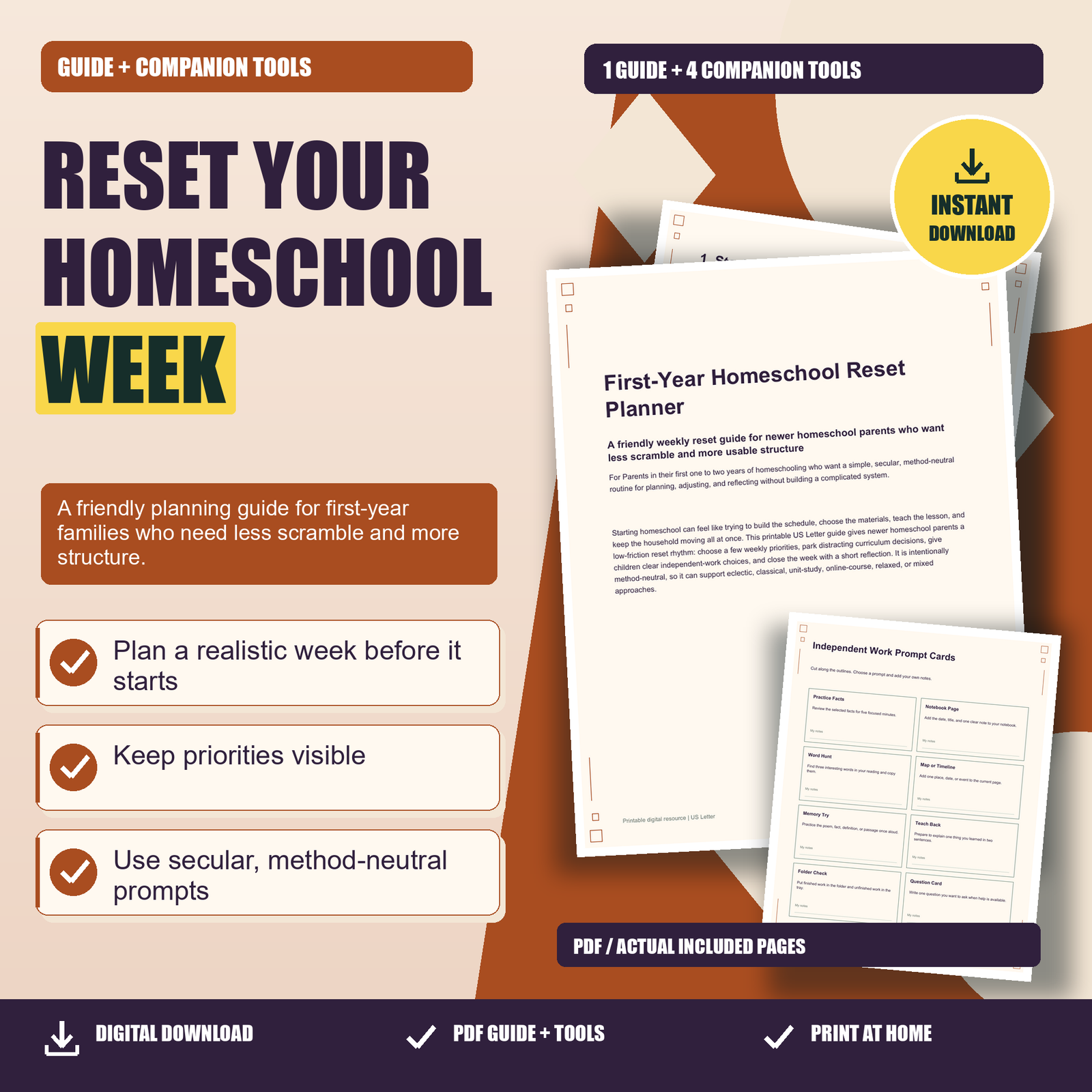
Printably Guides recommends choosing the smallest useful recovery plan: name what changed, pick the remaining must-do lessons, and move nonessential ideas to a later decision list. Add one catch-up block and one independent task so the week can continue without rewriting the whole plan.
1. Start With a Reset, Not a Perfect Plan
A first-year homeschool plan does not need to look like a school administrator’s binder. It needs to tell you what matters this week, what can wait, and what to do when the day gets wobbly. A reset routine works because it assumes real life will interrupt you. Instead of rewriting the whole plan every time a lesson runs long or a child resists a task, you return to a few visible priorities and make the next practical choice.
Begin each week by naming the main purpose of the week in plain language. Examples: “Get back to math after travel,” “Finish the library project,” “Practice starting the morning without arguing,” or “Keep lessons short while everyone is tired.” Then choose only a small number of must-do items. A must-do is not every page in the book. It is the lesson, conversation, practice, or project that would make the week feel meaningfully complete.
Worked example
Hypothetical inputs: 5 planned lessons, 2 completed lessons, 1 appointment day, and 1 independent reading task available. Arithmetic check: 5 planned minus 2 completed = 3 lessons left; choose 1 must-do lesson, move 2 to catch-up or next week, and assign the independent reading task while you prepare the must-do lesson.
2. Build a Weekly Rhythm You Can Repeat
A useful homeschool rhythm is not the same as a minute-by-minute schedule. New families often get discouraged when a detailed schedule fails by 9:30 a.m. A rhythm gives order without demanding precision. For example, your morning might always begin with reading aloud, then math, then a snack break, then independent work. The start time may shift, but the order remains familiar.
To create a weekly rhythm, divide the week into predictable blocks: focus lessons, independent work, read-aloud or discussion, outings or errands, catch-up space, and a short review. Place the hardest subject at the time of day when your child is most available. If mornings are best, protect that time for math, writing, or a live online class. If afternoons work better, keep mornings lighter and save direct instruction for later.
3. Choose Visible Priorities Before Choosing More Resources
New homeschool parents are often surrounded by choices: curriculum reviews, printable activities, online classes, manipulatives, workbooks, library lists, co-op suggestions, and advice from experienced families. Some of these resources may be genuinely helpful, but too many active decisions can make the week feel scattered. Before adding anything new, make your current priorities visible.
Write three categories for the week: learning priorities, family-life priorities, and support priorities. A learning priority might be “practice multiplication facts four days” or “write one clear paragraph.” A family-life priority might be “finish lessons before lunch on co-op day.” A support priority might be “ask another parent how they organize science supplies” or “find the library renewal date.” These categories keep planning practical instead of abstract.
4. Make Independent Work Clear Enough to Start
Independent work is not simply work a child does alone. It is work that has a clear start, a clear finish, and a level of difficulty the child can handle without constant adult direction. In the first year of homeschooling, many parents accidentally assign independent work that still requires them to explain every step. That can make both parent and child frustrated.
Start small. Choose tasks that are familiar, repeatable, and concrete: copy five spelling words, read two pages and mark one interesting fact, complete the next math review set, draw and label a science observation, listen to an assigned audio chapter, or organize yesterday’s work into a folder. Keep instructions short. If a child cannot repeat the direction back to you, the task is probably not independent yet.
5. Use Friday Reflection to Improve the System Gently
Reflection is not a report card for the parent. It is a way to notice what happened so next week can be easier to plan. Without reflection, homeschool weeks can blur together: you remember the hard moments, forget the small wins, and keep repeating the same overloaded plan. A short Friday review turns experience into useful information.
Set aside ten quiet minutes at the end of the week or before planning the next one. Open the Friday Reflection Journal and answer only the prompts that feel useful. Look for patterns, not perfection. Did math go better after a snack? Did independent work fail because the directions were unclear? Did a field trip create great conversation but make the next day too full? Those observations are planning clues.
Try the steps with one real example of your own. See the related Printably product for the tools and instructions included.