
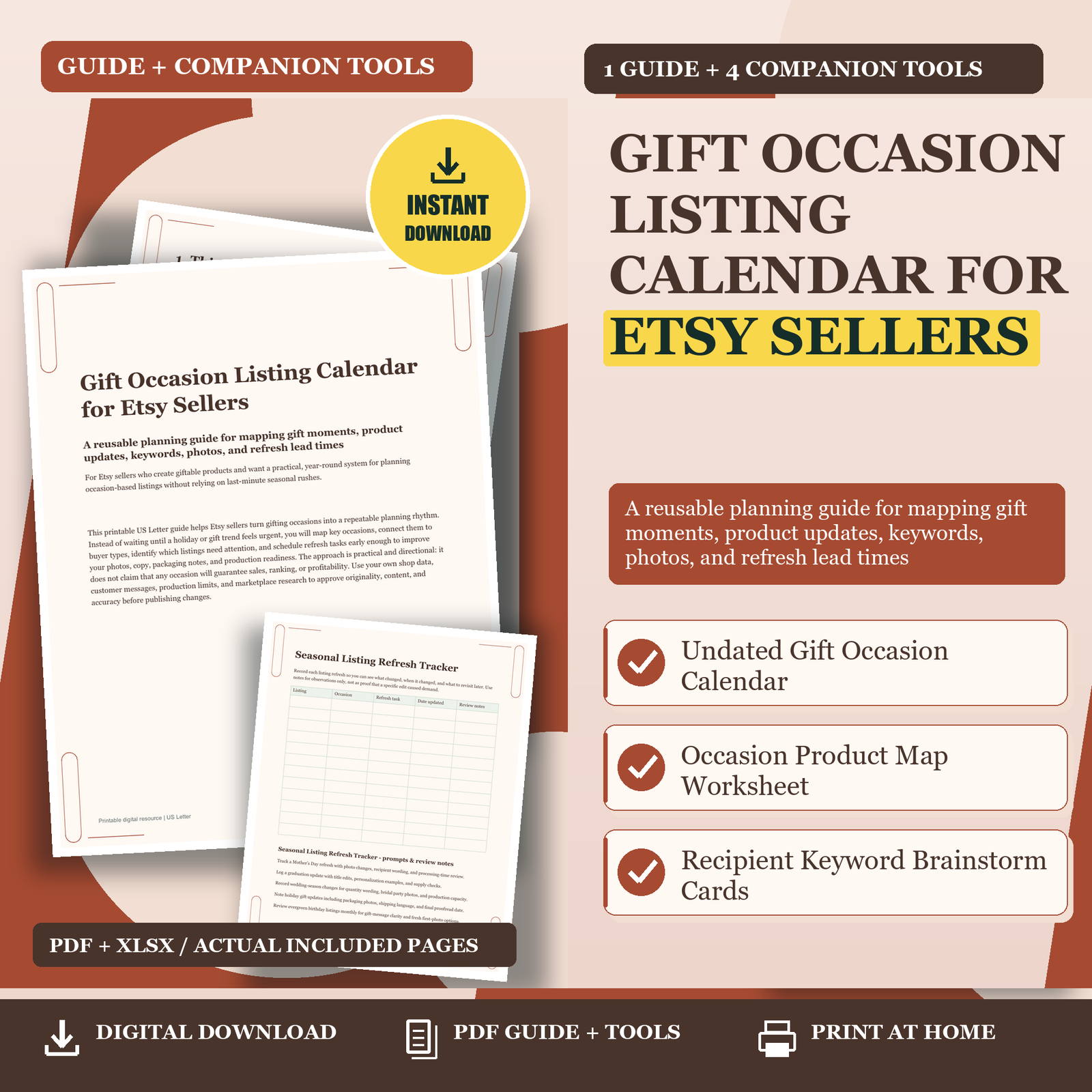
Gift Occasion Listing Calendar for Etsy Sellers: This printable US Letter guide helps Etsy sellers turn gifting occasions into a repeatable planning rhythm. Instead of waiting until a holiday or gift trend feels urgent, you will map key occasions, connect them to buyer types, identify which listings need attention, and schedule refresh tasks early enough to improve your photos, copy, packaging notes, and production readiness. The approach is practical and directional: it does not claim that any occasion will guarantee sales, ranking, or profitability. Use your own shop data, customer messages, production limits, and marketplace research to approve originality, content, and accuracy before publishing changes.
Gift Occasion Listing Calendar for Etsy Sellers: 1. Think in Gift Moments, Not Just Holidays
A strong gifting plan starts by widening your idea of what counts as an occasion. Major holidays matter, but many Etsy purchases are tied to smaller life moments: a new job, a first apartment, a teacher appreciation week, a bridesmaid proposal, a pet memorial, a baby shower, or a “thinking of you” package. These moments are useful because they reveal why a buyer is shopping and what they need the listing to communicate quickly. A mug is not just a mug when the buyer is searching for a retirement gift for Dad. A printable is not just wall art when it is being chosen for a nursery reveal or housewarming basket.
Begin by listing the occasions already connected to your products. Look through past reviews, order notes, personalization requests, gift messages, and customer questions. Circle repeated phrases such as “for my sister,” “teacher gift,” “wedding favor,” or “new home.” Then add adjacent occasions that fit naturally without forcing your product into an unrelated market. For example, if you sell personalized cutting boards, reasonable gift moments may include weddings, anniversaries, housewarmings, host gifts, and Father’s Day. Less obvious but still useful might be retirement parties or family recipe keepsakes. The goal is not to chase every date on the calendar; it is to identify the gift reasons your products can honestly serve.
2. Build a Reusable Occasion Calendar
Use an undated calendar so your planning system stays useful beyond one year. Start with twelve blank months and mark fixed annual occasions you may want to consider, such as Valentine’s Day, Mother’s Day, Father’s Day, Halloween, Christmas, Hanukkah, teacher appreciation periods, graduation season, wedding season, and back-to-school gifting. Then add flexible life-event categories that do not depend on a date: birthdays, sympathy gifts, new baby, new home, engagement, bridesmaid gifts, pet gifts, coworker gifts, and thank-you gifts. These flexible categories remind you to keep some evergreen listings polished even when no major holiday is approaching.
For each occasion, work backward. Ask: when do buyers start browsing, when do they need the item in hand, and how much time do I need for production, photography, listing edits, and shipping buffers? A made-to-order embroidered sweatshirt may need a longer planning window than an instant download card. A wedding favor listing may need sample photos and quantity wording months ahead of peak wedding season, while a teacher thank-you printable might need a shorter refresh cycle. Write planning tasks before the shopping moment, not on the shopping date. For example: six to eight weeks before graduation season, review titles and photos; four weeks before, update processing language and gift messaging; two weeks before, check stock, mockups, and personalization instructions. Treat these windows as planning guides, not guarantees of demand.
3. Match Products to Occasions Before Editing Listings
Before you rewrite titles or create new products, map what you already sell. Choose one occasion and list the products that genuinely fit it. Then decide whether each product is ready, needs a light refresh, needs a new photo angle, or should not be used for that occasion. This step prevents vague seasonal editing. Instead of adding “Mother’s Day gift” to every listing, you can identify which items truly suit moms, grandmothers, stepmoms, new moms, dog moms, or mother-in-law gifts, and which ones do not. Honest matching improves clarity and helps you avoid confusing buyers with irrelevant occasion language.
Use a simple product map with columns for occasion, recipient, product or listing, update needed, and lead time. For example, a candle shop might map “housewarming” to “new home candle,” recipient “friend or neighbor,” update “add lifestyle photo near entryway,” and lead time “refresh six weeks before moving season marketing.” A digital stationery shop might map “teacher appreciation” to “thank-you card bundle,” recipient “teacher,” update “add classroom-themed preview image,” and lead time “refresh four weeks before local appreciation weeks.” If an occasion requires a product variation, note whether you need new personalization fields, different packaging photos, color options, or clearer quantity instructions. Small, specific updates usually work better than broad seasonal claims.
4. Brainstorm Recipient Keywords with Buyer Intent
Recipient keywords help your listing speak to the person the buyer is shopping for. Start with plain-language recipients: mom, dad, sister, brother, teacher, coworker, boss, bride, groom, bridesmaid, new homeowner, pet lover, book lover, nurse, coach, graduate, neighbor, or best friend. Then add relationship and situation modifiers: first Mother’s Day, long-distance friend, new teacher, retirement gift for coworker, personalized gift for grandma, or host gift for Thanksgiving. These phrases can inspire titles, tags, listing introductions, photo text, and product descriptions, but they should only be used when they accurately describe the item.
Separate brainstorming from publishing. During brainstorming, write freely and explore combinations. During editing, choose the strongest, most relevant phrases and check whether they match the product, photos, and buyer expectation. For instance, “bridesmaid proposal gift” suggests a very specific use: the product should look appropriate for a proposal box or wedding party moment. “Teacher appreciation gift” may need wording that fits classrooms, end-of-year thank-yous, or practical desk use. Use recipient cards to prompt new angles when a listing feels stale. Pull one card, write five buyer phrases, then choose one listing element to improve: a title phrase, first photo prop, personalization example, gift note wording, or FAQ answer.
5. Refresh Listings with a Repeatable Task Sequence
A listing refresh should be more than swapping a holiday word into a title. Work through a consistent sequence so each update improves the buyer experience. First, confirm the product fits the occasion. Second, review the first photo and ask whether the gift use is obvious within a few seconds. Third, update the opening description so it names the recipient and occasion naturally. Fourth, review personalization, sizing, processing times, and shipping notes. Fifth, check whether your tags, attributes, and categories still match the product. Finally, proofread the listing as if you were the buyer sending it directly to someone else.
Create a short refresh routine for each occasion. For wedding season, you might photograph the item with neutral ribbon, add a quantity note for bridal party orders, update description examples for bridesmaids and groomsmen, and check production capacity for multiple-item orders. For birthdays, you might add a gift-wrap photo, show age-neutral styling, and include “ships to recipient” language if accurate for your shop process. For teacher gifts, you might add an example gift message and clarify whether personalization includes the teacher’s name. Keep a tracker of what changed and when. This helps you avoid repeated guessing and gives you a record to compare against future shop observations, without assuming any one edit caused a result.
Choose one useful next step. Review the related product details, included formats and license before choosing the tools for your needs.