
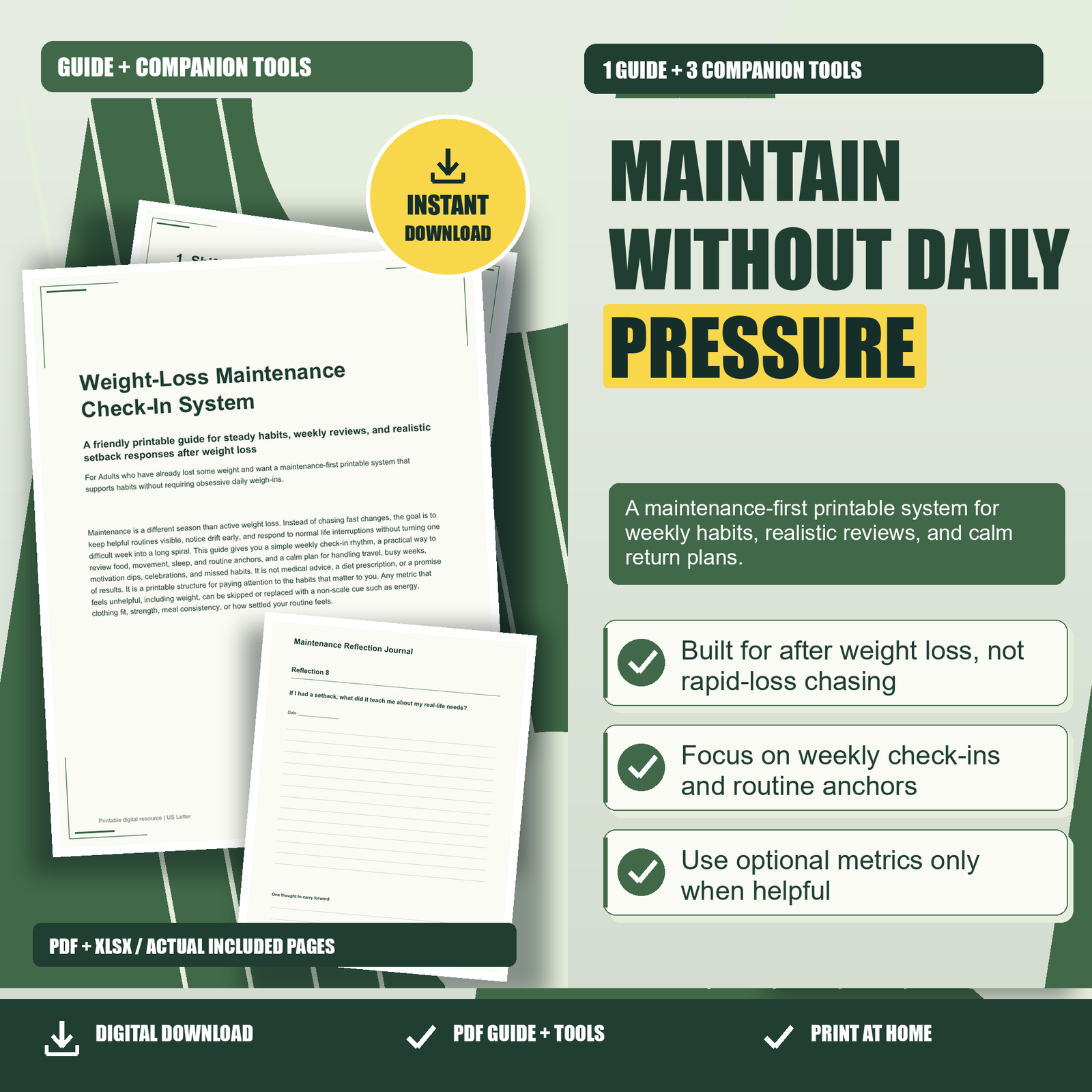
Use a weekly check-in that reviews a few anchor habits, such as planned meals, movement, sleep, or water, and treat weight as optional. If a metric feels stressful, replace it with a non-scale cue like energy, clothing fit, routine confidence, or how consistently you returned to your habits.
1. Shift From Losing Mode to Maintaining Mode
Weight-loss maintenance works best when you stop treating every week like a push for a new low and start treating it like a routine you can actually live with. During active weight loss, you may have focused on creating a calorie deficit, following a stricter plan, or checking progress often. In maintenance, the useful question changes from “How can I do more?” to “What keeps me steady when life is normal, busy, social, or imperfect?” This printable system is built around that shift. You are not trying to prove discipline every day. You are learning which habits protect your progress and which situations tend to loosen your routine.
Start by naming your maintenance anchors. These are simple behaviors that make the rest of your week easier: planning two or three balanced meals, keeping satisfying protein or fiber-rich foods available, walking after work, drinking water before snacking, going to bed at a consistent time, or packing lunch on office days. Choose habits that are specific enough to check off and flexible enough to survive a real week. “Eat perfectly” is not an anchor. “Include a planned lunch on workdays” is. The Weekly Maintenance Habit Tracker helps you record these anchors without turning your day into a long scorecard.
Worked example
Hypothetical inputs: weekly habits are planned lunches, two walks, and bedtime by 10:30; optional metric is skipped. At the end of the week, you completed planned lunches on 4 workdays, took 2 walks, and had 3 late nights, so the practical next step is to keep the lunch plan, repeat the walking goal, and set a smaller bedtime target for 2 nights.
2. Build a Weekly Check-In That Takes Ten Minutes
A weekly check-in gives you enough information to notice patterns without asking you to monitor every bite or weigh in every morning. Pick a consistent day and time, such as Sunday evening, Monday morning, or Friday lunch. Pair it with something you already do: making coffee, planning groceries, reviewing your calendar, or resetting your bag for the week. The goal is not to grade yourself. The goal is to ask, “What helped this week, what got in the way, and what small adjustment would make next week easier?”
Use the Weekly Maintenance Habit Tracker as a quick review. Write the week’s date, choose two to four anchor habits, and note how they went. You might track movement days, planned meals, sleep consistency, water, alcohol boundaries, restaurant choices, or a personal cue like hunger awareness. Keep the categories broad enough that they help you see trends. For example, instead of writing down every snack, you might record “planned afternoon snack available” or “evening grazing trigger noticed.” This keeps the focus on routines rather than perfection.
3. Keep Habit Tracking Flexible, Not Obsessive
The most useful tracker is the one you can keep using when you are busy, tired, traveling, or not feeling motivated. A rigid tracker often works only during easy weeks. A maintenance tracker should be more forgiving. Instead of tracking everything, choose the few habits that have the biggest effect on your routine. For many adults, this includes a meal-planning habit, a movement habit, a sleep or recovery habit, and a response habit for social meals or cravings. Your list may be different, and that is fine.
Try setting “minimum,” “standard,” and “strong” versions of a habit. For movement, a minimum version might be a ten-minute walk, a standard version might be a planned workout, and a strong version might be a workout plus extra steps. For meals, a minimum version could be including a protein-rich option at breakfast, a standard version could be planning lunches, and a strong version could be prepping ingredients for several meals. This prevents all-or-nothing thinking. A minimum habit still counts because it protects the identity of being someone who returns to routine.
4. Plan for Setbacks Before They Happen
A setback is not proof that maintenance has failed. It is information. Travel, illness, celebrations, deadlines, family stress, and motivation dips are ordinary parts of life. The problem is not the interruption itself; the problem is having no return plan. Without a plan, one missed workout can turn into a month away from movement, or one weekend of unplanned eating can turn into “I already ruined it.” A maintenance-first system assumes interruptions will happen and prepares a response ahead of time.
The Setback Response Checklist is designed for this moment. When you notice drift, start with a pause rather than a punishment. Identify what changed: schedule, food environment, sleep, stress, social events, emotions, or expectations. Then choose a low-friction return step. This could be buying familiar groceries, drinking water with the next meal, taking a walk, packing lunch tomorrow, planning two dinners, or going to bed on time. The first step back should be small enough that you can do it even when you are frustrated.
5. Use Reflection to Find Your Personal Maintenance Patterns
Reflection turns tracking into learning. Without reflection, a tracker can become a row of checkmarks that does not change anything. With reflection, you begin to see which routines are genuinely supportive and which ones are unrealistic. The Maintenance Reflection Journal gives you space to ask useful questions after each week or after a noticeable change. You do not need to write pages. A few honest sentences can be enough: “I skipped lunch twice and was very snacky at night,” “walking after dinner helped cravings,” or “I need a travel breakfast plan.”
Try reflecting in three categories: what worked, what was hard, and what you will adjust. What worked might be a grocery list, a planned restaurant order, a walking buddy, or a consistent bedtime. What was hard might be a stressful meeting, a late sports practice, a celebration weekend, or boredom with your usual meals. The adjustment should be concrete. “Do better” is too vague. “Prep a lunch option before Tuesday,” “keep yogurt and fruit at work,” or “choose two restaurant meals before the trip” gives you something to act on.
Try the steps with one real example of your own. See the related Printably product for the tools and instructions included.