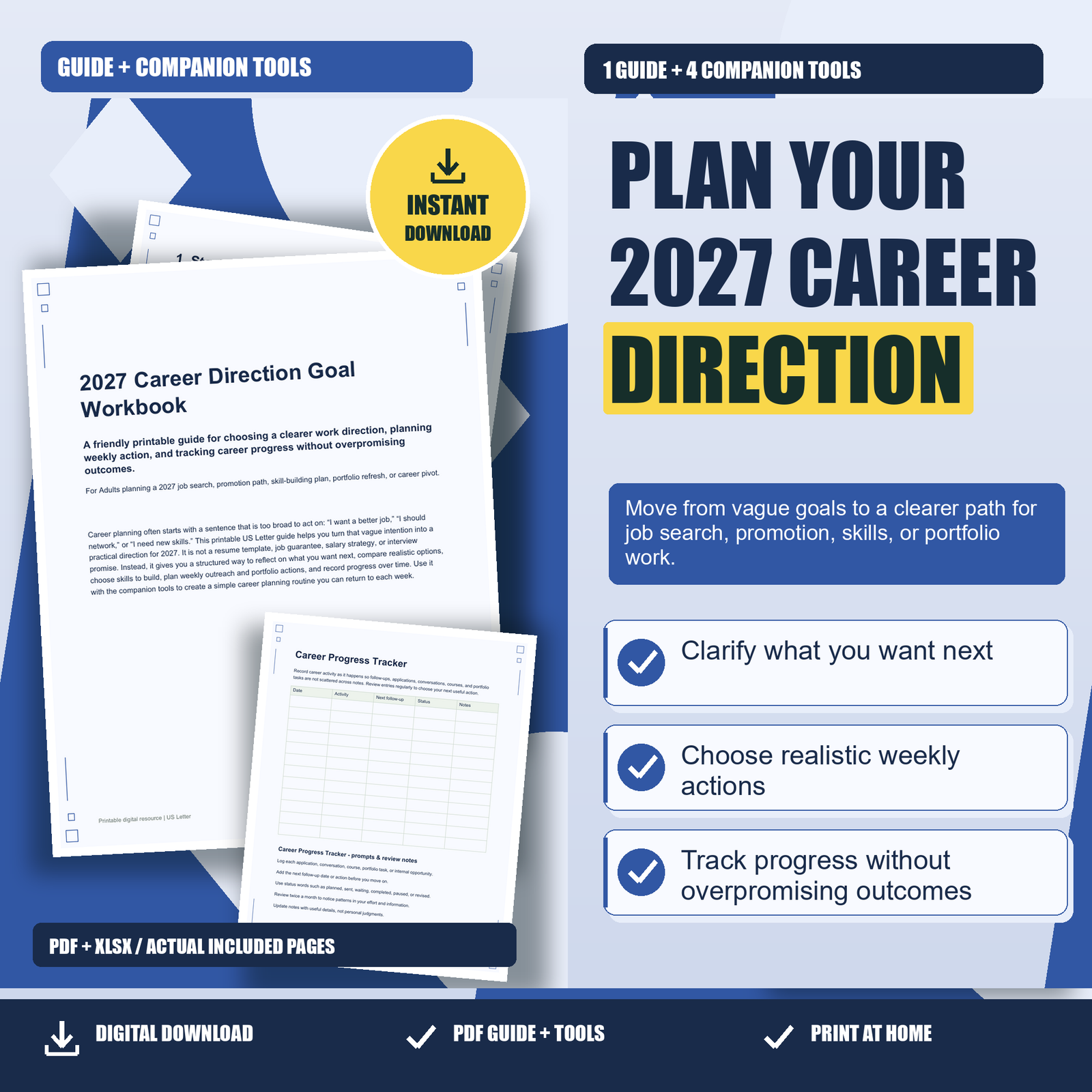
Write one clear direction sentence, identify one to three skill or evidence gaps, then choose two to five weekly actions you can control. Track each action with a status and next follow-up so your plan can be reviewed and adjusted instead of staying vague.
1. Start With Direction Before You Start With Tasks
A career goal becomes easier to work on when it has a direction, not just a wish. Instead of beginning with “find a better job,” write a clearer sentence: “In 2027, I want to move toward project coordination roles in mission-driven organizations,” or “I want to prepare for an internal team lead opportunity by building evidence of mentoring, planning, and communication.” This direction does not have to be perfect. It should simply be specific enough to guide your next actions. Start by naming three things: the kind of work you want more of, the work conditions that matter to you, and the evidence you already have. Evidence may include completed projects, volunteer work, training, presentations, client feedback, process improvements, or times you solved a problem.
Use the Career Direction Workbook to separate preference from proof. Preference is what sounds appealing; proof is what shows you have started building the foundation. For example, “I like creative work” is useful, but “I redesigned three internal guides and enjoyed simplifying information” is stronger for planning. Once you see both, you can choose a direction that is meaningful and grounded. If you feel stuck between several options, do not try to decide your entire future in one sitting. Pick one direction to test for 30 to 90 days through conversations, small projects, learning tasks, and portfolio updates. The goal is not instant certainty; it is making your next step visible.
Worked example
Hypothetical input: “I want a project coordination role in 2027.” Direction sentence: “I will explore project coordination roles and build evidence in scheduling, stakeholder updates, and project summaries.” Skill gaps: scheduling tools, update writing, and project documentation. Weekly actions: compare 3 role descriptions, message 1 project coordinator, draft 1 project summary, and log all 4 actions in the tracker; arithmetic check: 3 + 1 + 1 = 5 planned actions.
2. Turn Vague Goals Into Workable 2027 Objectives
A workable career objective includes a target, a reason, and a next action. “Network more” is vague because it does not say who, why, or when. A stronger version is: “Contact two people per month who work in operations roles so I can understand common responsibilities and language.” “Learn data skills” becomes more useful when written as: “Complete one beginner spreadsheet or reporting project and add the result to my portfolio notes by March.” Your objective should be something you can influence. You cannot control whether a company replies, whether an opening appears, or whether a manager approves a promotion. You can control research, outreach, practice, documentation, applications, follow-ups, and reflection.
For 2027, choose no more than three active objectives at a time. One may focus on role clarity, one on skill-building, and one on visible evidence. For example: research five target roles, complete two portfolio pieces, and schedule monthly career conversations. If you add too many objectives, your plan can become a list of pressure instead of a guide. Write each objective in plain language and attach a simple measure: number of conversations, courses reviewed, applications submitted, portfolio tasks completed, or feedback notes collected. Measures are not guarantees of results. They are signals that you are showing up consistently. Review your objectives monthly and edit them when your information improves. A good career plan is allowed to become more accurate as you learn.
3. Identify Skill Gaps Without Turning Them Into Self-Criticism
Skill-gap planning works best when it is practical and neutral. A gap does not mean you are behind; it means there is a difference between a target role and your current evidence. Start by choosing one target path, such as a promotion track, a related role, a new industry function, or an updated portfolio direction. Then review several role descriptions, internal expectations, or project examples. Look for repeated skills rather than one-off requirements. If “stakeholder communication,” “data reporting,” or “project scheduling” appears often, those skills may be worth examining. Avoid building your plan around every possible qualification. A realistic skill plan focuses on the few abilities that would make your next step more credible.
Use the Skill Gap Worksheet to list a target skill, your current evidence, a practice action, and a review date. For example, if your target skill is “presenting project updates,” your current evidence might be “shared weekly written updates with my team.” Your practice action could be “prepare a five-minute project summary for a manager or mentor and request feedback.” That is more useful than simply writing “get better at communication.” Choose practice actions that produce evidence: a sample report, a case study, a certificate of completion, a documented project, or a reflection note from a conversation. Evidence helps you see progress and gives you material to discuss when appropriate. Keep your skill plan manageable by selecting one to three skills per quarter.
4. Build a Weekly Career Action Rhythm
Career progress often comes from small repeatable actions, not one giant planning session. A weekly rhythm gives you a place to decide what matters now. At the start of each week, choose one main focus: role research, outreach, applications, portfolio updates, learning, or internal visibility. Then pick two to five actions that fit your time and energy. Examples include updating one portfolio project description, sending one thoughtful message, reviewing two job descriptions for common language, completing one lesson, asking a manager about promotion expectations, or organizing examples of your work. Keep your actions specific enough that you know when they are done.
The Weekly Career Action Planner is designed to help you turn direction into a short list for the week. Use it to name your focus, schedule actions, plan outreach, and review what happened. Outreach does not have to be dramatic. It can be a message to a former colleague, a question to someone in a target role, a follow-up after an event, or a check-in with a mentor. If you are applying for roles, separate application actions from relationship-building and learning actions so your week is not defined only by responses you cannot control. At the end of the week, write one useful observation. Maybe a role is less appealing than expected, a skill appears more often than you thought, or your portfolio needs clearer project outcomes. Those observations keep your plan alive.
5. Track Progress in a Way That Helps You Adjust
Tracking is not about proving you did enough. It is about remembering what you tried, what is waiting on a follow-up, and what patterns are emerging. Without a tracker, career activity can feel scattered: a course started here, an application sent there, a conversation you meant to follow up on, a portfolio task half finished. The Career Progress Tracker gives you one place to record the date, activity, next follow-up, status, and notes. You can use it for applications, career conversations, courses, internal opportunities, portfolio tasks, research steps, or feedback requests. The value is in seeing your activity clearly enough to make your next decision.
Review your tracker at least twice a month. Look for simple patterns rather than dramatic conclusions. Are you spending all your time researching and very little time reaching out? Are you applying broadly but not updating your examples? Are you learning skills without creating evidence of practice? Are several follow-ups overdue? These patterns suggest adjustments. For example, if you have completed several lessons but have no work sample, add a small project to next week’s plan. If you have many saved roles but no conversations, schedule one outreach action. Tracking cannot guarantee any outcome, and it should not be used to judge your worth. It is a decision tool that helps you choose the next useful action.
Try the steps with one real example of your own. See the related Printably product for the tools and instructions included.