
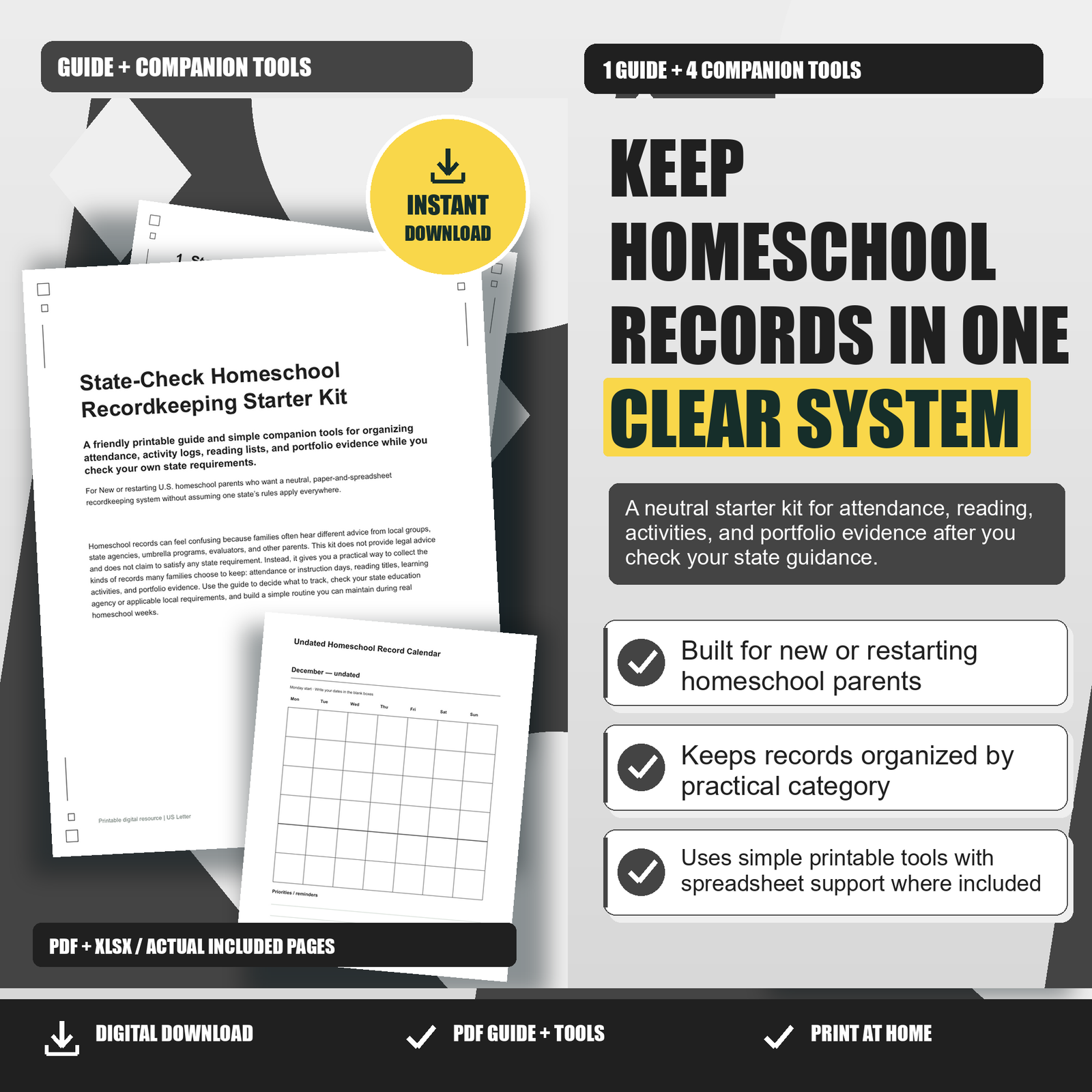
First, check your current state education agency or applicable requirement source and write down the record categories mentioned. Then set up separate places for attendance, reading and activities, portfolio evidence, and monthly calendar notes so each record has one clear home.
1. Start With Your State Check, Then Build the System
Before you print a tracker or label a folder, take one careful step: check your current state education agency guidance or the official source that applies to your homeschool situation. Homeschool requirements vary widely. Some families are asked to keep attendance, some maintain portfolios, some report specific information, and some keep parent-held records for their own protection and planning. Rules can also change, so the goal is not to copy what another family does in a different state. The goal is to understand what you personally need to retain, then use a simple structure to make those records easier to gather.
A practical state-check note can be brief. Write down the date you checked, the source you used, and the record categories mentioned. For example: “Checked state education agency page on August 10. Noted attendance, course list, and examples of student work.” Then translate that into your home system: attendance goes in the Attendance and Instruction Days Tracker, books and learning activities go in the Reading Titles and Activity Log Worksheet, student samples are sorted with the Portfolio Evidence Sorting Checklist, and your week-by-week plan or memory notes go on the Undated Homeschool Record Calendar. This keeps the system neutral and flexible instead of tied to assumptions about one location.
Worked example
Hypothetical inputs: a parent sees that attendance and samples may matter for their situation. They record Monday as one instruction day in the Attendance and Instruction Days Tracker, log a history read-aloud in the Reading Titles and Activity Log Worksheet, place a map activity in the portfolio folder, and mark the month-end review on the Undated Homeschool Record Calendar.
2. Choose Record Categories You Can Actually Maintain
A recordkeeping system works best when each type of information has one obvious place to land. For a starter system, use four categories: attendance or instruction days, reading titles, learning activities, and portfolio evidence. Attendance records show when school happened. Reading records capture books, articles, read-alouds, audiobooks, or subject reading. Activity records help you remember labs, field trips, projects, lessons, co-op classes, nature study, museum visits, math practice, writing assignments, and other learning experiences. Portfolio evidence preserves selected samples that show work over time.
Do not try to record every sentence your child reads or every conversation you have. Instead, decide what level of detail you can keep consistently. A useful entry might be: “Sept. 12, 2026 — 4 hours — math lesson, independent reading, map activity, library science program.” That is more useful than a blank page caused by perfectionism. If your state or program asks for specific details, add those details to your routine. If not, keep your entries plain and factual. The best system is one you will still use in February, not just during the first week of school.
3. Track Attendance and Instruction Days Without Overcomplicating It
The Attendance and Instruction Days Tracker is designed for routine recordkeeping, not legal interpretation. Use it to mark the date, learner, instruction time or day count, subjects or activity focus, and any notes you may want later. Some families track full days, some track hours, and some simply note whether instruction occurred. Your state-check step should guide the detail level you choose. If you are unsure, record more factual information rather than less, but avoid turning the tracker into a diary that takes too long to maintain.
A simple daily entry can be completed in under a minute: date, checkmark for instruction day, main subjects, and a short note. Example: “Oct. 3 — instruction day — math, reading, history timeline, piano practice — kept worksheet sample.” If you homeschool multiple children, you can use one line per learner or one line per family day with notes that clarify who participated. At the end of each week, review the tracker for missing dates. At the end of each month, total only what your household has chosen to total, such as days completed or instructional hours, and keep the tracker with your other records.
4. Make Reading and Activity Logs Useful, Not Performative
Reading lists and activity logs are most helpful when they remind you what learning actually happened. The Reading Titles and Activity Log Worksheet gives you a place to capture titles, authors or sources, subject area, date range, and a brief learning note. Use it for novels, read-alouds, independent readers, textbooks, biographies, documentaries paired with discussion, research websites, poems, science articles, and other learning materials. If a resource is informal, describe it clearly instead of worrying about perfect bibliographic style.
Activities can be logged in the same practical spirit. Instead of writing “science,” write “tested which materials absorb water; drew results.” Instead of “field trip,” write “county history museum; compared tools, clothing, and maps from different time periods.” These short notes help you reconstruct the year when you prepare a portfolio, meet with an evaluator, update a transcript planning file, or simply reflect on progress. You do not need to record every page number unless your situation requires it. Aim for specific, searchable language: title, topic, subject, and what the child did with the material.
5. Sort Portfolio Evidence as You Go
A portfolio is easier to assemble when you collect possible evidence throughout the year instead of hunting for it all at once. The Portfolio Evidence Sorting Checklist helps you decide what to keep, what to photograph, what to scan or copy, and what to discard after recording. Evidence might include writing samples, math pages, project photos, lab sheets, artwork, reading responses, maps, tests, presentations, certificates from classes, or notes from an educational outing. Keep samples that show variety, effort, skill growth, or completed work across subjects.
Choose a simple rhythm: once a week, place possible evidence in a temporary folder; once a month, sort it. Ask three questions: Does this show a subject or skill? Does it represent the child’s work clearly? Would it help explain what we did later? You do not need to keep every worksheet. In fact, saving too much can make the final portfolio harder to use. Select a manageable set of samples, label each with the date and subject, and connect it to your attendance or activity log when helpful. This creates a record trail without requiring a complicated filing system.
Try the steps with one real example of your own. See the related Printably product for the tools and instructions included.