
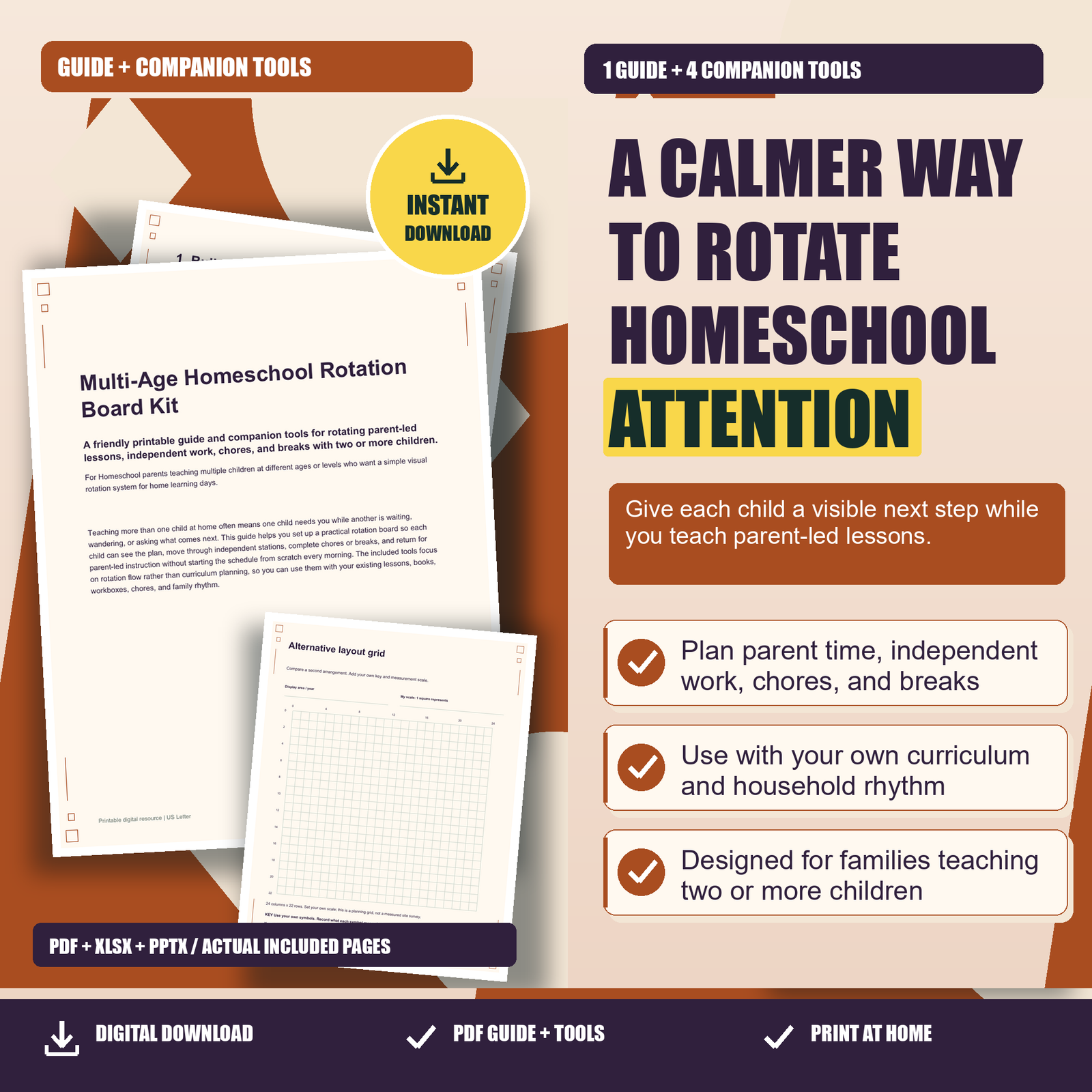
List which blocks need your direct attention, then give every other child a clear independent station, chore, or break during that time. Keep the rotation visible, use short station prompts, and track completion with brief notes so tomorrow’s plan can adjust.
1. Build the Rotation Around Attention, Not Subjects
A useful multi-age rotation does not begin with a perfect subject list. It begins with the reality of your attention. In most homeschool homes, the parent is the limited resource: one child needs a phonics lesson, another needs math help, a toddler may need supervision, and household tasks still exist. Instead of asking, “How do we fit every subject into a schedule?” ask, “When does each child need direct help, and what can everyone else do safely and productively during that time?” This small shift makes the rotation easier to maintain because the board is organizing movement and responsibility, not trying to replace your curriculum plan.
Start by naming your repeating station types. A simple set might be Parent Lesson, Independent Work, Reading, Chore, Creative Table, Movement Break, and Quiet Choice. Then decide which stations require you and which can run without you. For example, a seven-year-old may meet with you for reading while a ten-year-old completes math review and a preschooler uses pattern blocks nearby. After 20 minutes, the seven-year-old moves to copywork, the ten-year-old comes to you for a writing conference, and the preschooler gets a snack or picture-book bin. The goal is not to make every child do the same thing. The goal is for every child to know what to do next.
Worked example
Hypothetical inputs: 3 children and four 20-minute blocks. Arithmetic check: 4 × 20 minutes = 80 minutes, so you might teach Child A in Block 1, Child B in Block 2, read aloud together in Block 3, and teach Child C in Block 4 while the others rotate through reading, math practice, chores, and movement breaks.
2. Choose a Rotation Length Your Home Can Actually Hold
A rotation block should be long enough for a child to begin meaningful work but short enough that the household does not unravel before the next transition. Many families do well testing 15, 20, 25, or 30 minute blocks, but the right length depends on ages, attention spans, lesson intensity, and the amount of supervision required. Younger children often need shorter blocks with more movement, while older children may appreciate fewer transitions and longer independent work time. If your first plan falls apart, do not treat that as failure. Treat it as information about the size of the block, the clarity of the station, or the amount of adult help needed.
To test your rhythm, plan only one half-day rotation first. For example: Block 1, Parent Lesson with Child A while Child B reads and Child C plays at the table; Block 2, Parent Lesson with Child B while Child A finishes workbook pages and Child C does a puzzle; Block 3, group snack and read-aloud; Block 4, chores and outdoor break. Watch for the moment when children begin asking repeated questions. That is often the sign that the station needs a clearer prompt, a smaller task, or a visual cue. Use the Weekly Rotation Planning Grid to sketch blocks before committing them to your visible board.
3. Make the Board Visible, Flexible, and Calm
A rotation board works best when it is visible enough for children to check without asking you every few minutes. It does not need to be fancy. You can place Today’s Learning Rotation Signs on a clipboard, refrigerator, wall pocket, whiteboard, or tabletop stand. The important part is that the current sequence is easy to see: who is with the parent, who is working independently, who is doing a chore, and who is on a break. Use names, initials, colors, or simple icons depending on your children’s reading levels. If a child cannot read yet, pair the child’s name with a picture cue or consistent color.
Keep the board calm by limiting how much information appears at once. A crowded board can become another thing to manage. Instead of listing every page number, write the station name and keep the assignment in the child’s basket, folder, or notebook. For example, the sign might say “Maya: Independent Math” while the actual workbook is already open in her bin. If the morning changes because of an appointment or a slow start, edit the rotation rather than abandoning it. Cross off a block, combine chores, or move a parent lesson to the next day. A practical board gives direction without making the family feel trapped by the first plan.
4. Set Up Independent Stations That Reduce Repeated Questions
Independent stations succeed when children know the action, the stopping point, and what to do if they get stuck. “Do reading” may be too vague. “Read one chapter, mark one favorite line, then place the book in your finished basket” is much easier to follow. Before expecting a station to run smoothly, model it once or twice. Show where supplies live, how much work is expected, what neat completion looks like, and whether the child should ask for help immediately or save questions for the next parent check-in. This is especially helpful for mixed ages because the same station name may look different for each child.
Use the Independent Station Prompt Cards as cut-apart reminders at work areas, in bins, or beside the rotation board. A card such as “Question Parking: Circle the problem and move on” gives a child a specific action when they are stuck, rather than interrupting every parent-led lesson. A card such as “Chore Reset: Clear, wipe, return supplies” makes household help part of the rhythm instead of a separate battle. Rotate cards gradually. Introduce a few that match your current needs, then add others once the routine is familiar. The purpose is not to fill every minute; it is to make the next responsible action obvious.
5. Track Completion Without Turning the Day Into Paperwork
A completion tracker should answer simple questions: Who did which station? What still needs attention? Did a pattern appear across the week? It should not become a second curriculum record or a complicated grading system. The Student Rotation Completion Tracker is designed for quick checkoffs and short notes, so you can see whether a child finished independent work, needed support, skipped a chore, or should repeat a station tomorrow. For a busy homeschool parent, brief and consistent notes are usually more helpful than long comments written only once in a while.
Try using one row per child per day or one row per rotation block, depending on your preference. For example, you might write “Eli, Tuesday, Math Review, Done, needed help with regrouping” and then move on. At the end of the week, scan the tracker for useful patterns. If one child rarely completes independent writing, the task may need to be smaller or placed earlier in the day. If chores are often missed, they may need their own visible card or a more defined stopping point. The tracker is not there to judge the day. It gives you a memory aid so tomorrow’s plan can be slightly better informed.
Try the steps with one real example of your own. See the related Printably product for the tools and instructions included.