
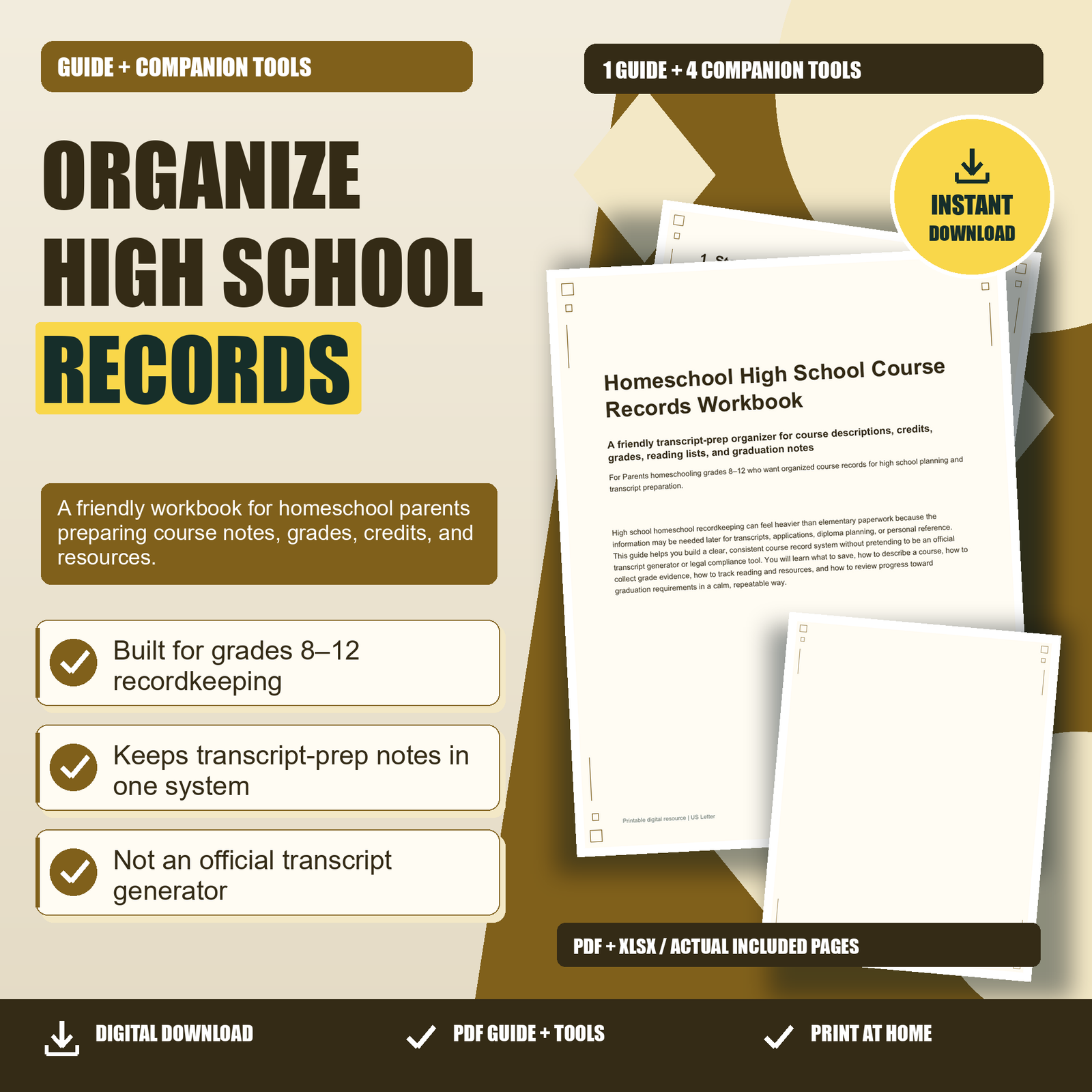
Create one record section per course, then save a short course description, grade evidence, credit note, and reading or resource list. At the end of each term, compare the completed courses with your graduation plan and flag any missing documentation before you summarize anything for transcript prep.
1. Start With the Purpose of the Record
A strong homeschool high school record does not have to be complicated, but it does need to be understandable later. Think of each course record as a short explanation of what your student studied, how much work was completed, what materials were used, and how the final grade or credit decision was supported. This is different from making an official transcript. A transcript usually summarizes course titles, credits, grades, and graduation details. A course record supports that summary by keeping the background information in one place. When you separate “supporting records” from “official-looking transcript output,” the work becomes much less intimidating.
Begin by creating a record folder for each student and school year. Inside it, keep one section for course descriptions, one for grade and credit evidence, one for reading and resources, one for activities or achievements, and one for graduation planning notes. If your student is in grade 8 but taking high-school-level work, record it clearly rather than waiting until 9th grade to reconstruct it. For example, “Algebra I, completed in grade 8 for high school credit consideration” is more useful than a vague note that says “math.” Your goal is not perfection; it is a record that a future version of you can understand without guessing.
Worked example
Hypothetical input: Biology, 1 planned credit, two semesters, textbook, lab notebook, chapter tests, and a final project. Steps: write a Biology course description, log each test/lab/project as grade evidence, list the textbook and lab manual in the resource log, then mark Biology as completed on the graduation checkup if your family plan requires 1 science credit. Arithmetic check: 0.5 credit fall + 0.5 credit spring = 1.0 credit total.
2. Build Course Descriptions While the Course Is Fresh
Course descriptions are easiest to write while the student is still doing the work. Waiting until senior year often leads to vague wording, missing book titles, and forgotten assignments. A useful course description usually includes the course title, grade level or term, subject area, main topics, primary materials, major assignments or labs, assessment methods, and the credit amount you plan to assign. Keep the wording plain and specific. Instead of “English was completed with novels and essays,” write “English 10 included American literature selections, weekly vocabulary, literary analysis discussions, four formal essays, and grammar review.”
Use consistent course titles, but do not overcomplicate them. “World History,” “Biology with Lab,” “Geometry,” and “English 9” are clear. If the course is customized, add enough detail to explain it: “Environmental Science: Ecology and Conservation” tells more than “Science.” A good practice is to write a rough description at the start of the course, then update it at the end. At the beginning, list planned topics and materials. At the end, revise the description to match what actually happened. If a course changed direction, that is fine—your record should reflect the real learning, not the original plan you abandoned in October.
3. Record Credits and Grades With Evidence
Credits and grades should be tied to records you can explain. This guide does not calculate GPA or tell you what your state, umbrella school, or future college will require. Instead, it helps you keep the evidence you used when making parent-issued course decisions. Evidence might include tests, quizzes, essays, lab reports, projects, portfolios, reading responses, discussion notes, practice logs, performance rubrics, or final exams. The important part is that your grade is not just a memory; it connects to work your student completed.
Choose a simple grading evidence habit before the course begins. For a traditional academic course, you might record major tests, written assignments, projects, and final grades. For a project-heavy course, you might record milestones, completed products, photos, rubrics, or written reflections. For music, art, physical education, or career exploration, you might log practice hours, performances, completed modules, mentor feedback, or project outcomes. At the end of the term, review your evidence before assigning the final grade and credit. Write a short note such as, “Final grade based on chapter tests, lab notebook, two research assignments, and final exam.” That one sentence can save confusion later.
4. Keep Reading and Resource Lists That Explain the Course
Reading lists and resource logs make course records more credible and easier to remember. They are especially helpful for English, history, science, foreign language, electives, and self-directed studies. A reading log does not need to include every webpage your student glanced at, but it should capture the books, textbooks, primary resources, documentaries, courses, lab manuals, articles, and substantial learning tools that shaped the course. Include the title, author or creator when known, date or term used, and a short note about how it was used.
For example, a U.S. Government course might include a textbook, founding documents, selected court case summaries, current events articles, and a final civics project. A British Literature course might include novels, poems, plays, literary analysis essays, and discussion notes. A Computer Applications course might include tutorial modules, completed documents, spreadsheets, presentations, and a final project. When the resource list is connected to the course description, it gives context without requiring you to keep a mountain of paper. If your student uses library books or online resources, log them when they are used rather than relying on memory months later.
5. Track Activities Without Turning Everything Into a Course
High school learning includes more than academic classes. Volunteer work, clubs, athletics, music, employment, leadership, competitions, apprenticeships, family responsibilities, community service, and personal projects can all become useful activity records. Not every activity needs to become a credit-bearing course. Sometimes the best record is simply a clean activity note: what the student did, when they did it, the approximate time involved, responsibilities held, skills practiced, and any awards or outcomes.
Create an activity record when an experience shows growth, responsibility, service, leadership, creativity, or persistence. For example, “Volunteer assistant at community garden, spring and summer, helped plant, weed, harvest, and distribute produce” is more useful than “volunteering.” If the activity becomes substantial enough to support an elective credit, write a course description and evidence note. If not, keep it in the activity section. This keeps your transcript-prep records balanced: academic courses remain clear, and meaningful experiences are not lost. Review activities at the end of each semester so you can capture details while they are still accurate.
Try the steps with one real example of your own. See the related Printably product for the tools and instructions included.