
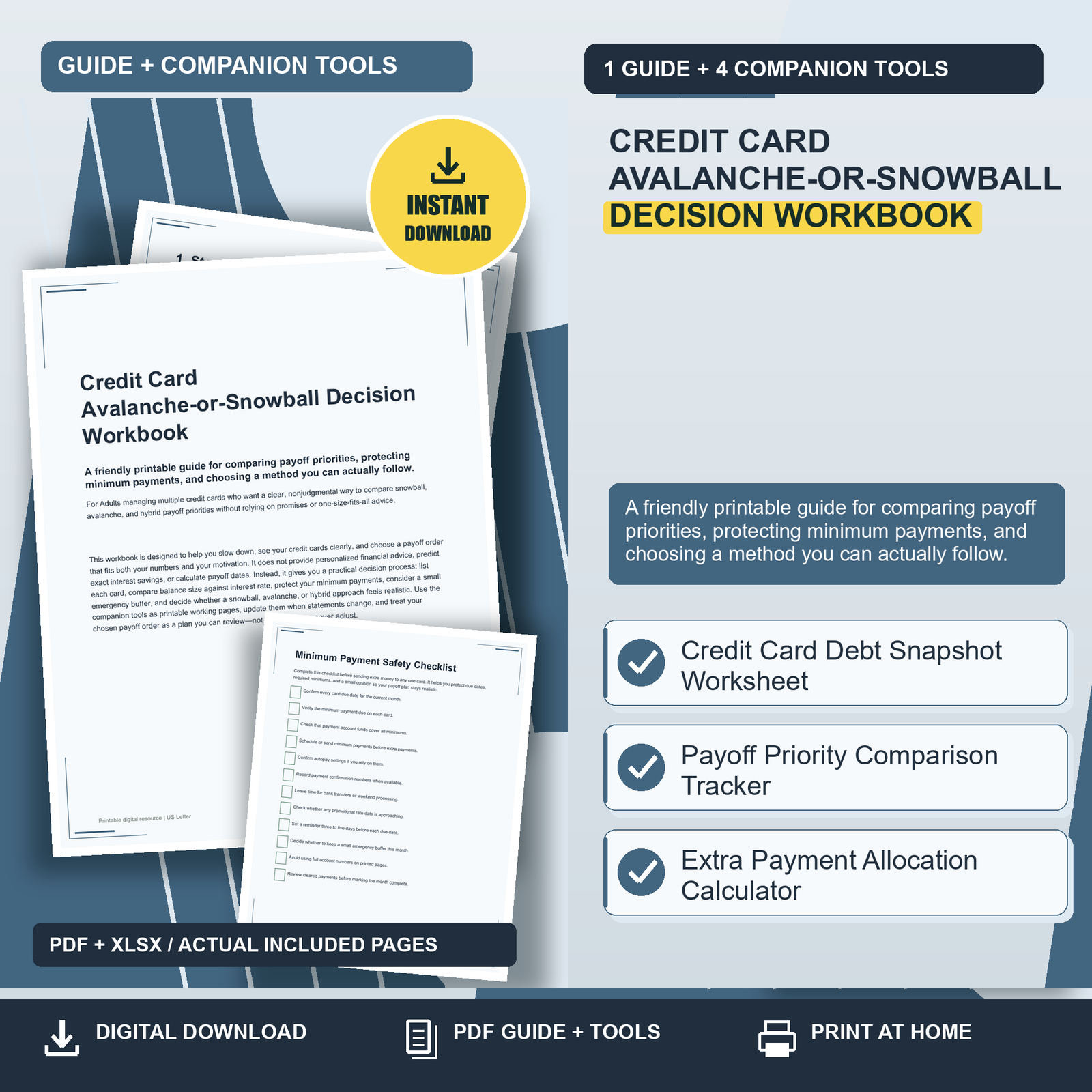
Credit Card Avalanche-or-Snowball Decision Workbook: This workbook is designed to help you slow down, see your credit cards clearly, and choose a payoff order that fits both your numbers and your motivation. It does not provide personalized financial advice, predict exact interest savings, or calculate payoff dates. Instead, it gives you a practical decision process: list each card, compare balance size against interest rate, protect your minimum payments, consider a small emergency buffer, and decide whether a snowball, avalanche, or hybrid approach feels realistic. Use the companion tools as printable working pages, update them when statements change, and treat your chosen payoff order as a plan you can review—not a rule you can never adjust.
Credit Card Avalanche-or-Snowball Decision Workbook: 1. Start With a Calm Snapshot, Not a Perfect Plan
When you have several credit cards, the hardest step is often not math—it is gathering the facts without spiraling into shame or urgency. Begin by making a simple snapshot of every card you want to include. Write down the card nickname, current balance, interest rate if available, minimum payment, due date, and any notes such as promotional periods or annual fees. Do not worry yet about which card should be paid first. The goal is to turn scattered statements, apps, and reminders into one visible list. For example, you might label cards as “Gas Card,” “Travel Card,” and “Store Card” instead of using full account numbers. Once everything is in one place, circle any due date coming up soon and highlight any minimum payment that feels difficult. This first step creates breathing room. You are not solving the entire debt situation today; you are building a reliable starting point for comparison.
2. Understand the Three Payoff Styles
A snowball method generally focuses extra money on the smallest balance first while paying minimums on the others. The appeal is emotional momentum: paying off a small card can feel encouraging and reduce the number of open balances. An avalanche method generally focuses extra money on the highest interest rate first while paying minimums on the others. The appeal is interest awareness: higher-rate balances are often more expensive to carry. A hybrid method blends the two, such as clearing one small balance first for motivation and then switching to the highest-rate card, or prioritizing a high-rate card unless a tiny balance can be eliminated quickly. None of these labels automatically makes a plan right for every person. The best method for your workbook is the one you understand, can maintain, and can revisit if your budget changes. This guide helps you compare the tradeoffs without promising exact savings or a perfect payoff timeline.
3. Compare Logic and Motivation Side by Side
After you list your cards, create two rankings: one by balance from smallest to largest and one by interest rate from highest to lowest. This gives you a snowball view and an avalanche view. Then add a personal motivation note beside each card. For example, a $320 store card might rank first for snowball because it is the smallest balance, but a $4,800 card at a high APR might rank first for avalanche. Your notes might say “quick win,” “stressful due date,” “high interest,” or “promotional rate ending soon.” This comparison is useful because it prevents the decision from becoming all-or-nothing. If the smallest balance is also high interest, your choice may feel easy. If the smallest balance has a low rate and another card has a much higher rate, you can decide whether motivation or interest awareness matters more right now. The point is not to judge your priorities; it is to make them visible before you commit extra payments.
4. Protect Minimum Payments Before Sending Extra
Extra payments are helpful only when the foundation is safe. Before choosing a target card, check that you can make at least the minimum payment on every card by its due date. Missing a minimum can create fees, penalty rates, credit reporting issues, or added stress, depending on the account terms. Build a simple monthly minimum-payment routine: list due dates in order, mark whether autopay is active, confirm the payment account has enough money, and note when each payment clears. If your cash flow is irregular, consider scheduling reminders several days before the due date instead of relying on memory. This workbook also encourages a small emergency-buffer prompt because sending every spare dollar to debt may leave you vulnerable to reusing cards for minor surprises. The buffer does not have to be large to be useful. It is simply a pause point: before paying extra, ask whether this month’s essentials, minimums, and a modest cushion are covered.
5. Choose a First Target and Define “Extra” Clearly
Once minimums are protected, choose one target card for any extra payment. Define “extra” as money left after essentials, required minimums, and any buffer amount you choose to keep. Be specific. Instead of saying, “I’ll pay more when I can,” write “If $60 remains after minimums, I will send it to the target card,” or “I will use half of any overtime pay for the target card this month.” If you choose snowball, your first target is usually the lowest balance. If you choose avalanche, your first target is usually the highest interest rate. If you choose hybrid, write the rule clearly so you do not have to remake the decision every payday. For example: “Pay off the $250 card first, then switch to highest APR.” This clarity reduces decision fatigue. It also helps you notice when the plan needs revision because of a changed income, a new statement balance, or an unexpected expense.
Choose one useful next step. Review the related product details, included formats and license before choosing the tools for your needs.