
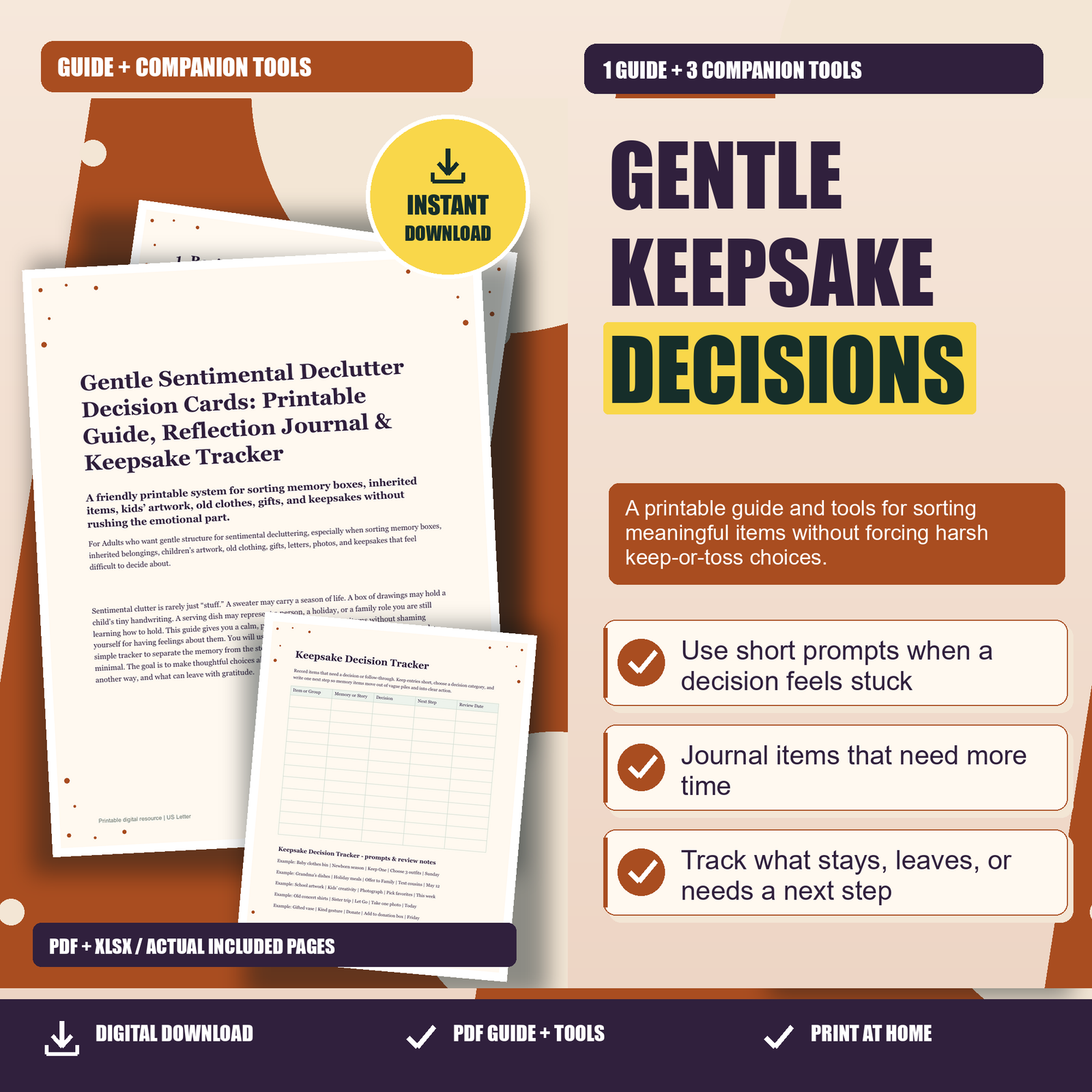
Gentle Sentimental Declutter Decision Cards: Sentimental clutter is rarely just “stuff.” A sweater may carry a season of life. A box of drawings may hold a child’s tiny handwriting. A serving dish may represent a person, a holiday, or a family role you are still learning how to hold. This guide gives you a calm, practical way to sort those items without shaming yourself for having feelings about them. You will use short decision prompts, a reflection journal, and a simple tracker to separate the memory from the storage decision. The goal is not to become perfectly minimal. The goal is to make thoughtful choices about what deserves space, what can be remembered another way, and what can leave with gratitude.
Gentle Sentimental Declutter Decision Cards:
1. Begin With a Gentle Sorting Space
Before you open the first box, set up a small, contained decision area. Sentimental decluttering becomes overwhelming when every item is visible at once, so choose one category and one surface: a memory box on the kitchen table, one drawer of children’s art, one tote of inherited linens, or one section of old clothing. Place four simple zones nearby: Keep, Let Go, Photograph, and Later. The Later zone is important because it prevents a hard item from stopping the entire session.
2. Use Prompt Cards to Slow the Decision Down
The Sentimental Declutter Prompt Cards are designed for moments when your mind gets stuck between “I should keep this” and “I should get rid of this.” Instead of arguing with yourself, draw one card and answer only that question. A prompt such as “Would I display this?” helps you distinguish between an item you truly want present in your life and one you are keeping because it feels wrong to release it. A prompt such as “Could a photo preserve enough?” opens a middle option when the story matters more than the object itself.
3. Decide What the Item Is Really Holding
Many keepsakes are containers for a story, a role, or a relationship. When every item feels important, ask what it is actually holding. Is it evidence of a loved one’s personality? A reminder of your own past identity? A symbol of a child’s growth? A record of family history? Once you name the role, you can choose a form that respects the memory without automatically keeping the object. Sometimes the original item is the right form. Sometimes a photo, a written note, a smaller sample, or a single representative piece is enough.
4. Create a Respectful Let-Go Process
Letting go of sentimental items can feel abrupt if the only options are “keep” or “trash.” Build a respectful exit process so release feels intentional. For items in good condition, consider donation, gifting to someone who genuinely wants the item, selling if appropriate, or repurposing. For paper items, you might photograph, scan with your own preferred method, keep a small sample, or write the memory in the journal before recycling. For worn clothing, you might save a patch, take a photo, or choose one garment from a larger group.
5. Use the Reflection Journal for Hard Decisions
Some items need more than a quick yes or no. The Memory Item Reflection Journal is for objects that bring up mixed feelings, family expectations, grief, identity, or uncertainty. Instead of leaving those items scattered across the room, place them in a Later box and write a short journal entry. Name the item, where it came from, what feeling it brings up, and what decision you are considering. This moves the emotional work onto paper so the physical sorting session can keep moving.
Choose one useful next step. Review the related product details, included formats and license before choosing the tools for your needs.