
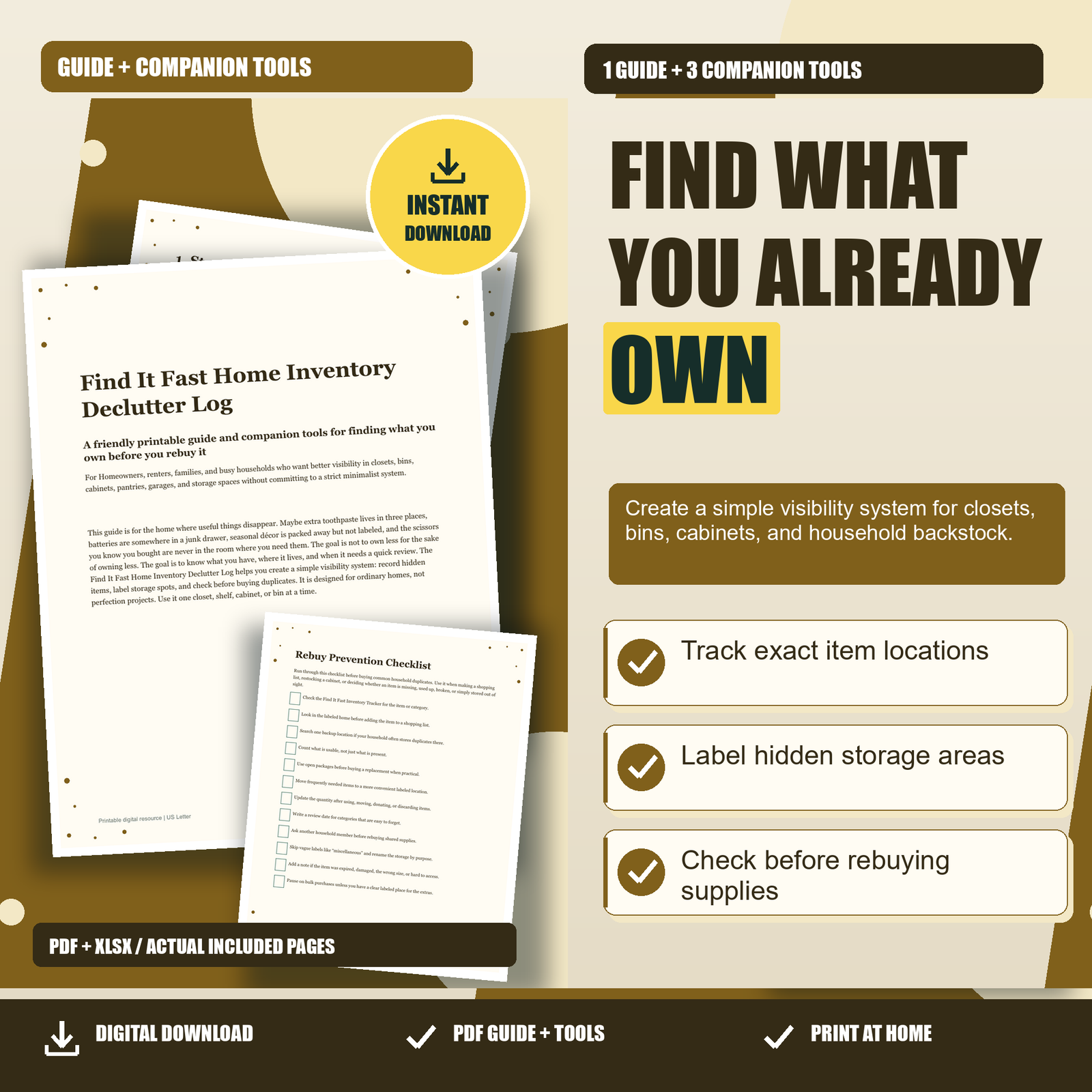
Find It Fast Home Inventory Declutter Log: This guide is for the home where useful things disappear. Maybe extra toothpaste lives in three places, batteries are somewhere in a junk drawer, seasonal décor is packed away but not labeled, and the scissors you know you bought are never in the room where you need them. The goal is not to own less for the sake of owning less. The goal is to know what you have, where it lives, and when it needs a quick review. The Find It Fast Home Inventory Declutter Log helps you create a simple visibility system: record hidden items, label storage spots, and check before buying duplicates. It is designed for ordinary homes, not perfection projects. Use it one closet, shelf, cabinet, or bin at a time.
Find It Fast Home Inventory Declutter Log:
1. Start With Visibility, Not a Full Purge
A lot of organizing advice starts with getting rid of things. That can be useful, but it is not always the real problem. Many homes have items that are practical, needed, and worth keeping; they are simply invisible. They sit in opaque bins, behind taller bottles, under linens, or in the wrong room because someone put them there “just for now.” When useful items become hard to see, the household starts rebuying them, overstuffing storage, and wasting energy searching.
2. Build a Simple Home Inventory That You Will Actually Use
The best home inventory for everyday organizing is short, plain, and easy to update. You do not need a museum catalog of every fork, sock, or paperback. Focus on items with one or more of these qualities: they are stored out of sight, bought in multiples, used seasonally, shared by several people, or frequently forgotten. Examples include first-aid refills, printer paper, school supplies, cords, spare toiletries, party supplies, holiday décor, pet medication reminders, repair parts, and bulk pantry extras.
3. Label Bins and Closets So the System Is Visible
Labels are not about making storage look fancy. They reduce guessing. A label tells you where something belongs, helps another person put it back, and reminds you what is hiding inside a bin before you buy another version. Labels are especially useful for opaque bins, high shelves, shared closets, deep cabinets, under-bed storage, garage totes, and seasonal containers.
4. Use Review Dates to Keep Storage From Becoming a Mystery Again
A home inventory becomes outdated when it never gets touched again. Review dates solve that problem without requiring constant maintenance. A review date simply means, “Check this category later.” It is not a deadline or a rule. It is a prompt to see whether the quantity still makes sense, whether the location still works, and whether anything should be used up before buying more.
5. Stop Rebuying by Adding a Pause Before Purchases
Rebuying usually happens in the gap between “I think we need that” and “I checked whether we have it.” A small pause can prevent duplicates from piling up. The Rebuy Prevention Checklist is designed for that moment. Before buying a common duplicate item, check the tracker, look in the labeled location, and ask whether the item is truly missing, used up, broken, or simply inconvenient to find.
Choose one useful next step. Review the related product details, included formats and license before choosing the tools for your needs.