
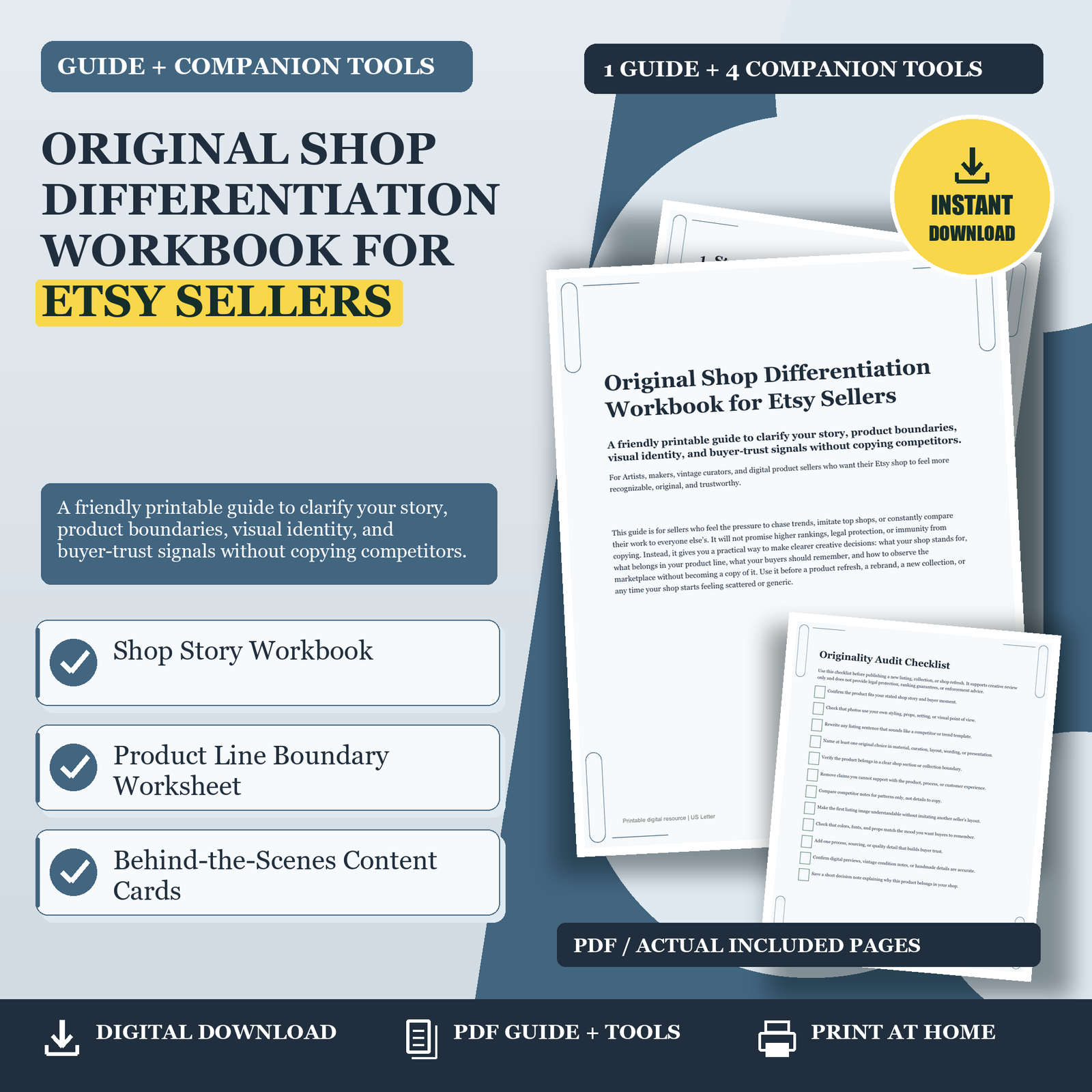
Original Shop Differentiation Workbook for Etsy Sellers: This guide is for sellers who feel the pressure to chase trends, imitate top shops, or constantly compare their work to everyone else’s. It will not promise higher rankings, legal protection, or immunity from copying. Instead, it gives you a practical way to make clearer creative decisions: what your shop stands for, what belongs in your product line, what your buyers should remember, and how to observe the marketplace without becoming a copy of it. Use it before a product refresh, a rebrand, a new collection, or any time your shop starts feeling scattered or generic.
Original Shop Differentiation Workbook for Etsy Sellers:
1. Start With the Difference Buyers Can Feel
Originality is not only about inventing something no one has ever seen before. For a small shop, originality often comes from the combination of your taste, process, story, materials, point of view, and consistency. A buyer may see hundreds of candles, prints, templates, jewelry pieces, vintage bundles, or crochet patterns. What helps them pause is not always a shocking new idea. It may be a recognizable mood, a thoughtful detail, a personal reason for the collection, or a clear promise about what kind of experience your shop offers.
Begin by naming the difference a buyer can actually feel. For example, instead of saying, “I sell minimalist wall art,” you might say, “I create quiet botanical prints for people who want their home office to feel calm without looking empty.” Instead of “I sell vintage home goods,” try, “I curate warm, useful kitchen pieces that feel like they came from a grandmother’s pantry, not a staged showroom.” These descriptions do not depend on copying anyone else. They give you a filter for photos, packaging, product titles, and future ideas.
2. Build a Shop Story That Does Real Work
A strong shop story is not a long autobiography. It is a short, useful explanation of why your work exists, what you care about, and why a buyer should trust your choices. Many sellers either avoid story completely or share details that do not connect to the product. The sweet spot is a story that helps the buyer understand the care behind the item. If you make ceramics, your story might explain your love of slow mornings and functional pieces that are meant to be held daily. If you sell digital planners, your story might explain your preference for gentle structure over overwhelming productivity systems.
Use three layers when writing your story. First, include your origin: what pulled you toward this category or style? Second, name your standard: what do you pay attention to that a rushed seller might ignore? Third, describe the buyer moment: where does your product fit into someone’s life? For example: “I started making embroidered bookmarks after collecting damaged library books and falling in love with handwritten notes in the margins. I choose sturdy fabric, slow stitching, and muted colors so each piece feels like a small keepsake. They are made for readers who like their everyday objects to feel personal.”
3. Set Product-Line Boundaries Before You Add More
One reason shops start to feel generic is that every promising idea gets added. A seller sees a trend, a seasonal rush, or a competitor’s bestseller and thinks, “Maybe I should make that too.” Experimenting is healthy, but a shop without boundaries becomes hard for buyers to understand. Product-line boundaries help you decide what belongs, what might belong later, and what should stay outside your shop even if it is popular.
Create three categories: core products, supporting products, and off-brand products. Core products are the items your shop should be known for. Supporting products make sense beside the core line, such as matching cards for art prints, care tags for handmade goods, or coordinated digital inserts for a planner shop. Off-brand products may be fun, profitable-looking, or trendy, but they weaken the shop’s identity. For example, a serene wedding stationery shop might decide that neon party invitations are off-brand, even if they are currently popular.
4. Observe Competitors Without Becoming a Copy
Competitor research can be useful, but it becomes harmful when it turns into imitation or panic. The goal is not to copy titles, photos, product concepts, color palettes, or bundle structures. The goal is to understand what buyers are seeing, where sameness is happening, and how your own shop can make clearer choices. Think of competitor observation as weather checking. You can notice the climate without dressing exactly like everyone else.
Use a three-column approach: market pattern, buyer expectation, your original response. A market pattern might be “many shops use beige backgrounds and dried flowers.” The buyer expectation might be “buyers may associate this look with calm, natural, handmade products.” Your original response could be “use my own workbench, blue-gray linen, and close-up process details instead of recreating the same beige scene.” This method lets you learn from the market without lifting someone else’s expression.
5. Use Process Content to Build Buyer Trust
Behind-the-scenes content is one of the simplest ways to show that your shop is real, thoughtful, and distinct. This is especially useful in a marketplace where buyers may worry about generic products, AI-generated sameness, dropshipping, or copied designs. You do not have to reveal private techniques, suppliers, or anything that makes you uncomfortable. The goal is to show enough of your decision-making and care that buyers can see there is a person, eye, or process behind the finished item.
Good process content answers quiet buyer questions. How is this made or selected? Why did you choose this color, material, phrase, shape, or era? What details did you reject? How do you check quality? What does the item look like before it is finished? For handmade sellers, this might be a photo of trimming threads, testing glaze samples, sketching variations, or packing orders. For vintage curators, it might be a sourcing note, condition-check routine, styling comparison, or explanation of age-related wear. For digital sellers, it might be a planning sketch, page organization decision, screen preview, or before-and-after layout cleanup.
Choose one useful next step. Review the related product details, included formats and license before choosing the tools for your needs.