
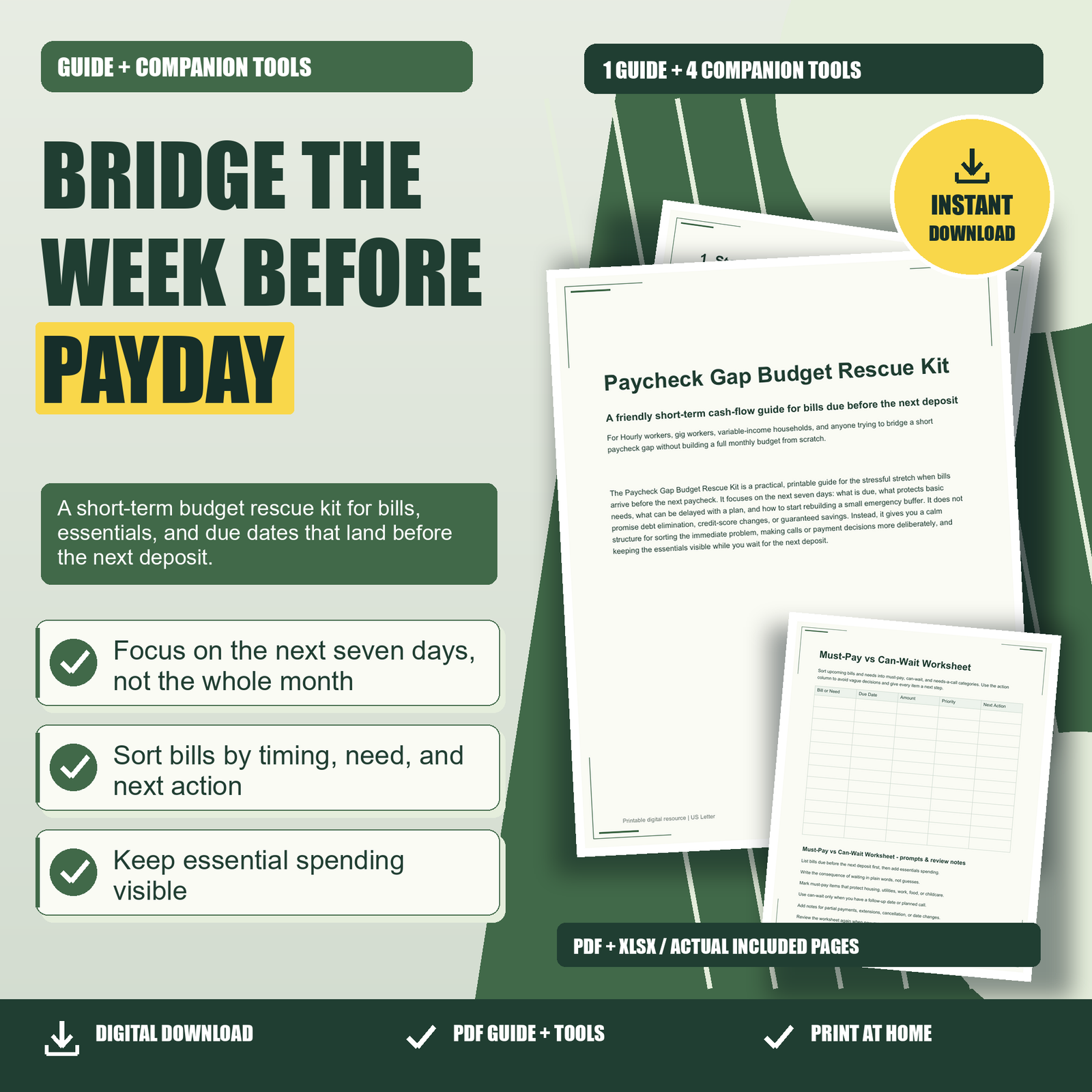
Printably Guides suggests starting with the days until your next deposit, then listing bills due before that date and marking essentials such as housing, utilities, food, work transportation, childcare, or medication. Compare each bill’s due date, amount, and known consequence, then choose a next action: pay, call, delay with a date, cancel, or review terms.
1. Start With the Gap, Not the Whole Month
When money feels tight, a full monthly budget can be too large to solve today’s problem. The first step is to define the exact gap you are trying to bridge. Look only at the days between now and your next expected deposit. Write down today’s date, the expected deposit date, the money currently available, and any money that is truly expected before then. Keep uncertain money, such as possible tips or a maybe-shift, separate until it actually arrives.
For example, if it is Monday, your next paycheck is Friday, and you have $86 available, your bridge period is four days. That does not mean every bill in the month has to be solved today. It means the immediate question is: what must be handled before Friday, and what can wait without creating a bigger problem? This kit is designed around that short-term view so you can reduce confusion and focus on the next useful action.
Worked example
Hypothetical inputs: available cash $86, expected side-job money $20, next paycheck Friday, gas $25, groceries $35, phone bill $40. Check the arithmetic: $86 + $20 = $106 available before Friday, and $25 + $35 + $40 = $100 planned, leaving $6; because the cushion is small, you might pause optional spending and call any biller you cannot safely pay on time.
2. List Every Due Date Before You Decide
A common paycheck-gap mistake is paying whichever bill is loudest first. Reminders, emails, and app notifications can make one bill feel urgent even when another bill protects a more basic need. Before choosing what to pay, make a due-date list. Include rent or housing, utilities, phone, transportation, insurance, childcare, minimum debt payments, subscriptions, and any automatic withdrawals that could hit your account during the gap.
Use the Bill Due Date Triage Checklist to slow the process down. Mark which bills are already overdue, which are due before the next deposit, and which are due after. Then note any late fee, shutoff risk, cancellation risk, or essential-service concern you already know about. If you are unsure, write “check terms” rather than guessing. The goal is not to make a perfect legal or financial judgment. The goal is to create a clear picture before money leaves your account.
3. Protect the Essentials First
During a short cash-flow gap, essentials-first thinking helps you separate needs from pressure. Essentials usually include safe housing, basic utilities, food, required transportation to work, necessary medication or health-related costs, and childcare needed to earn income. Your situation may be different, so use plain language: what must remain available so you can stay safe, get to work, and make it to the next deposit?
Next, compare each upcoming payment with the essentials list. A streaming subscription may be due sooner than the electric bill, but it may not protect the same need. A small bus pass may be more important than a larger nonessential purchase because it keeps you able to work. This is where the Must-Pay vs Can-Wait Worksheet is useful. Write the amount, due date, consequence of waiting, and your planned action. If something can wait, give it a specific follow-up date instead of leaving it floating in your head.
4. Build a Seven-Day Bridge Plan
Once the due dates and priorities are visible, map the next seven days. The Seven-Day Cash Flow Bridge Planner is not a full budgeting system; it is a short bridge between today and the next deposit. For each day, note expected money in, must-pay items, essential spending, and a quick check-in. This keeps daily decisions connected to the same plan instead of being remade from scratch every time you buy gas or groceries.
A simple example: you have $86 today, $20 expected from a side job on Wednesday, and a paycheck on Friday. Before Friday, you need $25 for gas, $35 for groceries, and a $40 phone payment. That totals $100 before the paycheck. Because $86 + $20 = $106, there is only a $6 cushion. Seeing that early may help you avoid an optional $12 purchase, call a biller before the due date, or choose the smallest grocery trip that still covers meals.
5. Make Calls and Delay Decisions With Notes
Sometimes the best short-term action is not immediate payment; it is communication and documentation. If you cannot pay a bill before the next deposit, contact the provider as early as you realistically can. Ask what options exist, whether a late fee applies, whether a partial payment helps, and when the account would be considered late. Avoid promising a payment date you do not expect to meet. Write down the date, who you spoke with, and the next step.
Keep the tone simple: “My paycheck is delayed until Friday. I’m reviewing bills due this week. Can you tell me what happens if I pay on Friday instead of Wednesday?” This kind of question helps you gather information for your worksheet. It is not legal or credit advice, and outcomes depend on the provider’s rules. But clear notes can reduce repeat calls, keep you from relying on memory, and help you choose the least disruptive next action.
Try the steps with one real example of your own. See the related Printably product for the tools and instructions included.