
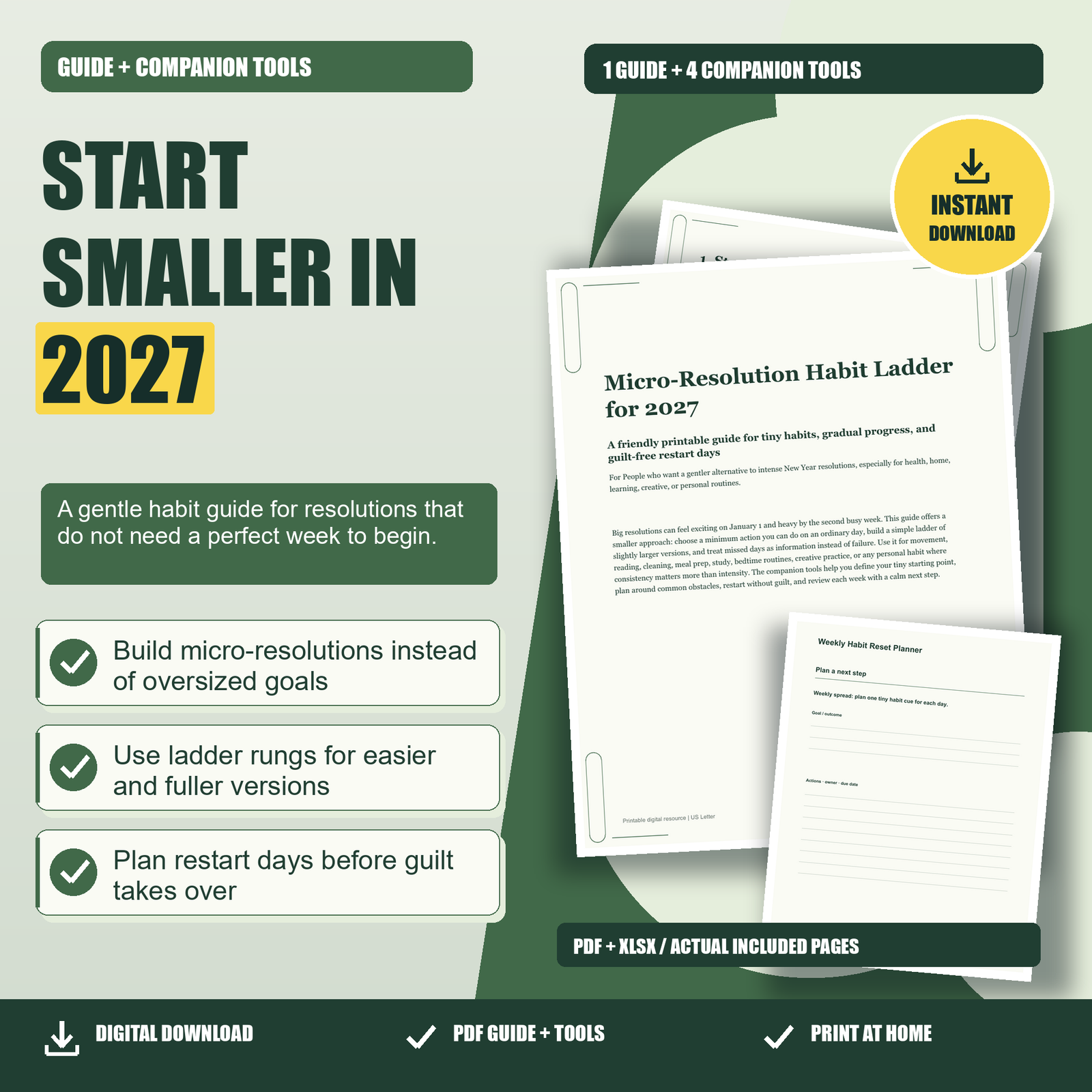
Choose the smallest action that still represents the habit, attach it to a daily cue, and write one slightly larger rung for ordinary days. If you miss a day, restart at the smallest rung and adjust the cue or friction point instead of adding a penalty.
1. Start With a Micro-Resolution, Not a Makeover
A micro-resolution is a promise small enough to keep when life is normal, not only when you feel motivated. Instead of “work out every day,” your micro-resolution might be “put on walking shoes after lunch” or “stretch for one minute before coffee.” Instead of “deep clean the house every weekend,” it might be “clear one visible surface after dinner.” The goal is to remove drama from the starting line. You are not proving discipline; you are creating a repeatable entry point.
To choose one, write the area you care about: health, home, learning, money routines, creativity, or relationships. Then name the smallest visible action that counts. It should be specific enough that you know whether it happened. “Read more” is vague. “Read one page after brushing my teeth” is clear. If the action feels almost too easy, that is often a useful sign. You can always climb later, but you cannot build consistency from a habit you avoid.
Worked example
Hypothetical inputs: habit = reading, cue = after brushing teeth, smallest rung = read one page, ordinary rung = read five pages. If Tuesday is missed, Wednesday’s restart is one page after brushing teeth; if that works, the next weekly reset can keep the cue and consider five pages on less busy nights.
2. Build a Ladder With Gentle Rungs
A habit ladder gives you more than one acceptable way to succeed. Each rung is a version of the same habit, starting with the minimum and gradually increasing. This is useful because your energy, schedule, and attention will not be identical every day. A ladder lets you match the action to the day without abandoning the habit completely.
Create four or five rungs. Rung one should take very little effort: one minute, one item, one page, one dish, one message, one glass of water, one paragraph. Rung two should be only a little bigger. Rung three can represent a satisfying standard day. Higher rungs are optional stretch versions, not proof that the lower rungs are worthless. For a home habit, your ladder might be: put one item away, reset one counter, spend five minutes tidying, reset the whole kitchen zone, do a weekly sweep. For movement: shoes on, walk to the mailbox, walk five minutes, walk fifteen minutes, add a strength set.
3. Attach the Habit to a Real-Life Cue
Tiny habits become easier to remember when they are attached to something that already happens. A cue might be brushing your teeth, starting the kettle, closing your laptop, feeding a pet, school pickup, or setting your phone to charge. The cue should be dependable and easy to notice. “When I have free time” is not a strong cue because it is vague. “After I put my dinner plate in the sink” is stronger.
Use an if-then sentence: “If I finish my morning coffee, then I fill my water bottle.” “If I sit down at my desk, then I open my notebook.” “If I turn off the TV, then I set out tomorrow’s clothes.” The If Then Action Prompt Cards are designed for this step. Cut them apart, choose one card that matches a situation you face often, and write a short action you can do immediately after the cue.
4. Track Consistency Without Chasing Perfection
Tracking works best when it gives you useful feedback without turning the habit into a punishment. A streak can be motivating, but it can also make one missed day feel like the whole effort is ruined. For micro-resolutions, track whether you returned to the habit and which rung you used. The minimum counts. A lower rung on a hard day is still a completed action.
In the Micro Habit Ladder Tracker, record the date, the rung completed, the cue used, and one quick note about what helped or got in the way. For example: “Jan 8, Rung 1, after lunch, rainy day but shoes on counted.” This note is more useful than a simple checkmark because it teaches you what conditions matter. If you repeatedly miss the same cue, the cue may need to change. If you always succeed with a one-minute version but avoid a ten-minute version, your next rung may be too steep.
5. Plan Restart Days Before You Need Them
Missed days are not an exception to habit-building; they are part of ordinary life. Travel, illness, extra work, family needs, low energy, weather, or simple forgetfulness can interrupt even a well-designed habit. The key is to decide in advance what a restart looks like so you do not have to negotiate with guilt later.
A restart day should be intentionally small. Return to rung one, use the easiest cue, and complete the action without adding a penalty. If your habit is decluttering, restart by putting one item where it belongs. If your habit is learning, open the book or app for one minute. If your habit is movement, put on shoes and step outside or stretch once. The Restart Day Checklist guides you through this kind of reset: name what happened, choose the minimum, remove one friction point, and schedule the next cue.
Try the steps with one real example of your own. See the related Printably product for the tools and instructions included.