
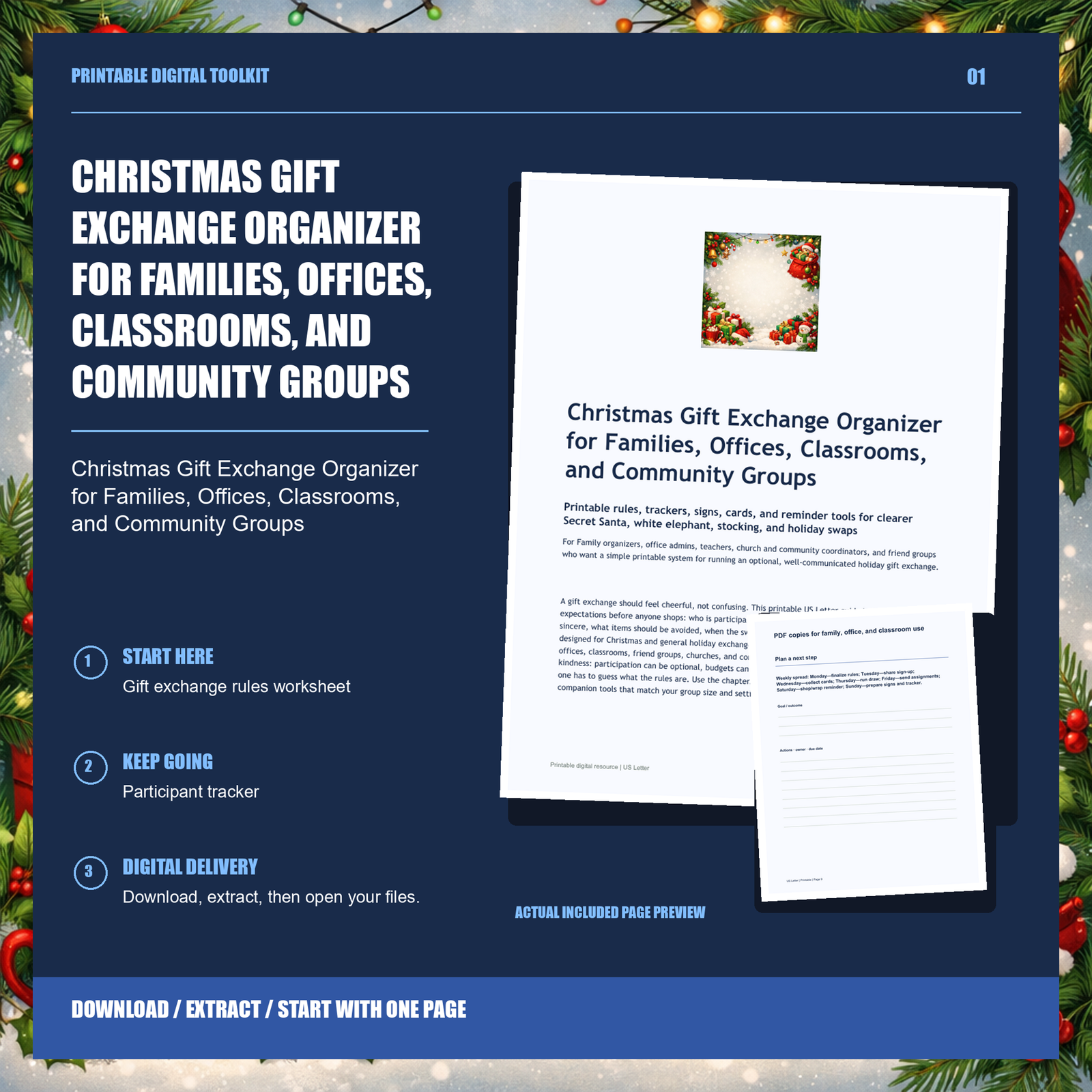
Christmas Gift Exchange Organizer for Families, Offices,: A gift exchange should feel cheerful, not confusing. This printable US Letter guide helps organizers set expectations before anyone shops: who is participating, what the budget is, whether gifts are silly or sincere, what items should be avoided, when the swap happens, and how reminders will be shared. It is designed for Christmas and general holiday exchanges, with wording that can be adapted for families, offices, classrooms, friend groups, churches, and community gatherings. The emphasis is clarity and kindness: participation can be optional, budgets can be realistic, preferences can be respected, and no one has to guess what the rules are. Use the chapters first to plan your exchange, then print the companion tools that match your group size and setting.
Christmas Gift Exchange Organizer for Families, Offices,: 1. Choose the Exchange Style Before You Invite Anyone
The easiest way to prevent confusion is to decide what kind of exchange you are hosting before you ask people to join. “Gift exchange” can mean many different things: Secret Santa, white elephant, stocking stuffer swap, classroom grab bag, themed basket exchange, ornament swap, book exchange, or a simple name draw among relatives. Each version creates different expectations. Secret Santa usually means one person buys for one assigned person. White elephant usually means wrapped gifts are chosen and sometimes stolen according to rules. A classroom swap may need very low-cost, non-food, equal-value items. An office exchange should be optional and respectful of workplace policies.
Start by writing one plain-language sentence that describes the exchange. For example: “This is an optional Secret Santa where each participant buys one wrapped gift for the person they draw, with a suggested budget of $15–$20.” Another example is: “This is a family white elephant game using new or gently unused items, with no gag gifts that could embarrass someone.” A clear sentence makes every later decision easier.
2. Set a Budget Band That Feels Fair and Flexible
Budget clarity is one of the most important parts of a successful exchange. Without it, one person may spend $5 while another spends $50, and both may feel awkward. A budget band is often friendlier than a single fixed amount because it gives people flexibility while still keeping the exchange balanced. For example, “around $10,” “$10–$15,” or “no more than $20” is easier to follow than an unstated expectation. If your group includes students, coworkers, extended family, or mixed-income participants, choose a modest range and make participation optional.
Use wording that reduces pressure. Instead of “Everyone must bring a $25 gift,” try “Optional gift exchange: if you would like to join, please bring one wrapped gift in the $10–$15 range.” For offices and classrooms, avoid language that makes gifting sound required. Teachers, admins, and group leaders may also need to follow local school, workplace, or organization policies, so keep the organizer’s role focused on coordination rather than enforcement.
3. Collect Preferences Without Making It Complicated
Wishlists are helpful because they turn guessing into thoughtful choosing. They are especially useful for family Secret Santa, office exchanges where people may not know each other well, classroom swaps, and church or community groups with wide age ranges. A good wishlist does not need to be long or demanding. It should give the giver a few safe directions, such as favorite colors, hobbies, snacks, sizes, books, beverages, sports teams, craft interests, or favorite stores. It should also include a gentle “please avoid” area for allergies, dislikes, or items that do not fit the recipient’s household.
Preference cards should be practical, not fussy. For example, a participant might write: “Likes: herbal tea, puzzles, blue, cozy socks. Please avoid: scented candles, peanuts.” Another might write: “Likes: art supplies, cats, mystery books. Please avoid: bath products.” These details help prevent unwanted gifts and reduce waste. For children’s exchanges, keep prompts age-appropriate: favorite character, favorite color, favorite activity, and items to avoid. If food is involved, allergy and dietary preference space is especially important, but organizers should not try to give medical guidance. Simply collect and share the participant’s stated preferences.
4. Run the Draw and Track Participants Clearly
The name draw is where many gift exchanges become messy. Someone forgets to join, spouses draw each other when the rule says they should not, a teacher ends up with uneven classroom participation, or an office admin loses track of who has confirmed. The solution is a participant tracker paired with a draw tracker. The participant tracker records who is in, whether they submitted a wishlist, whether they have special restrictions, and whether they have received the rules. The draw tracker records who gives to whom, without making the full list public if the exchange is meant to be secret.
Before drawing names, set your exclusions. Common family exclusions include “do not draw someone in your household” or “children draw only children.” Office exclusions might include “supervisors do not draw direct reports” if that fits the workplace culture. Classroom exchanges may skip individual name draws entirely and use a general grab bag to keep it simple. Friend groups may allow couples to participate separately or as one household. Whatever you decide, write it down before the draw so no one feels singled out.
5. Communicate Reminders Without Nagging
Most gift exchange problems happen because people forget a detail, not because they meant to ignore the rules. A reminder plan keeps the tone friendly and prevents repeated one-off questions. Plan three reminders: one at sign-up, one after the draw, and one shortly before the event. The first reminder explains the exchange type, optional participation, budget, theme, and deadline to join. The second reminder confirms each participant’s recipient or bring-a-gift instruction. The final reminder repeats the date, location, wrap instructions, and any avoid list such as “no alcohol,” “no food,” or “label allergens.”
Use short, positive wording. For example: “Friendly reminder: our optional holiday gift exchange is Friday at 2:00. Please bring one wrapped gift in the $10–$15 range if you signed up. Theme: cozy winter. Add a tag with your recipient’s name if you are doing Secret Santa.” For a classroom: “Reminder for families who chose to participate: please send one wrapped book by Thursday. Please do not send food items.” For a family group chat: “Name draw is complete! Please keep gifts around $20 and bring them wrapped to dinner on the 24th.”
Choose one useful next step. Review the related product details, included formats and license before choosing the tools for your needs.