
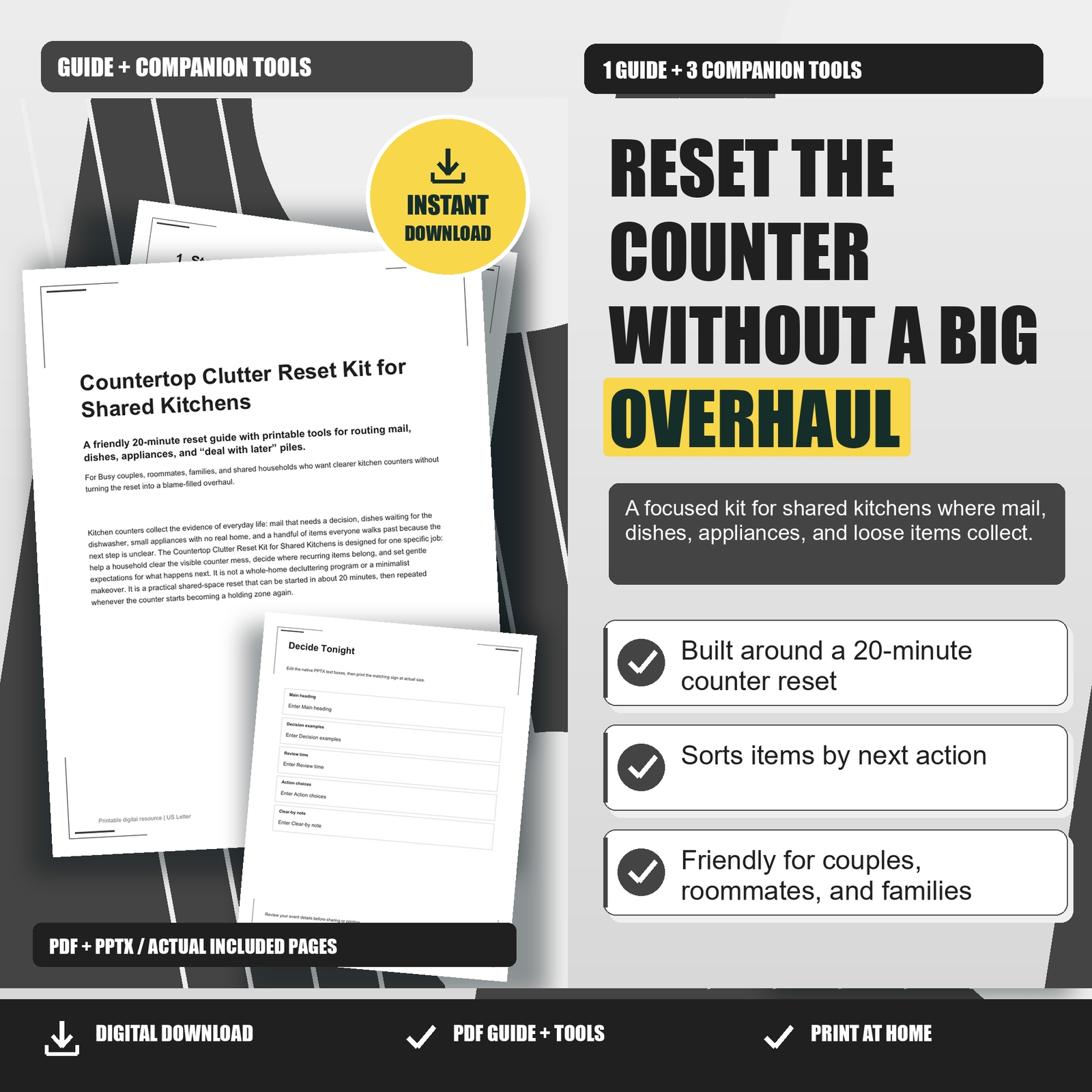
Kitchen counters collect the evidence of everyday life: mail that needs a decision, dishes waiting for the dishwasher, small appliances with no real home, and a handful of items everyone walks past because the next step is unclear. The Countertop Clutter Reset Kit for Shared Kitchens is designed for one specific job: help a household clear the visible counter mess, decide where recurring items belong, and set gentle expectations for what happens next. It is not a whole-home decluttering program or a minimalist makeover. It is a practical shared-space reset that can be started in about 20 minutes, then repeated whenever the counter starts becoming a holding zone again.
Countertop Clutter Reset Kit for Shared Kitchens:
1. Start With a 20-Minute Counter Reset, Not a Perfect Kitchen
A shared kitchen usually gets messy because it works hard, not because anyone has failed. Counters become the easiest drop zone when people are cooking, unloading bags, sorting mail, making lunches, or rushing between tasks. The first goal is not to design a perfect kitchen. The first goal is to make the counter usable again and remove the items that are quietly waiting for a decision.
2. Sort by Next Action Instead of by Person
Shared spaces often break down when clutter is treated as a personality problem. One person may think the counter is “obviously messy,” while another sees it as a temporary staging area. A more useful approach is to sort by next action. Every item on the counter needs one of a few simple outcomes: stay because it is used here, move because it belongs somewhere else, wait because a decision is needed, or leave because it is trash, recycling, donation, or no longer useful.
3. Create Counter Zones That Match Real Routines
A counter zone is a small, intentional area with a job. It is not a decorative category or a strict rule for every inch of counter space. In shared kitchens, zones work best when they match what already happens there. For example, a coffee zone may include the coffee maker, filters, mugs, and sweetener. A lunch-packing zone may need a clear stretch of counter near bags and containers. A daily landing zone may hold keys, one tray of mail, and a reminder note, but not every loose object in the home.
4. Use Neutral Signs to Set Expectations Without Blame
In a shared kitchen, a sign is not about policing people. It is a small communication tool that answers the question everyone silently has: “Where should this go?” The Shared Kitchen Reset Signs are built around neutral language so the counter can be managed without turning every item into a household conflict. Phrases such as “belongs elsewhere,” “decide tonight,” and “daily landing zone” focus on the item’s next step rather than on who left it there.
5. Make the Reset Repeatable for Busy Days
A reset only helps long term if it can survive normal life. Shared households rarely maintain a counter because of one big cleaning session. They maintain it through small, repeatable habits that are easy to restart after a busy week. Choose a reset time that is attached to something already happening: after dinner, before trash night, Sunday evening, or while coffee brews in the morning.
Choose one useful next step. Review the related product details, included formats and license before choosing the tools for your needs.